

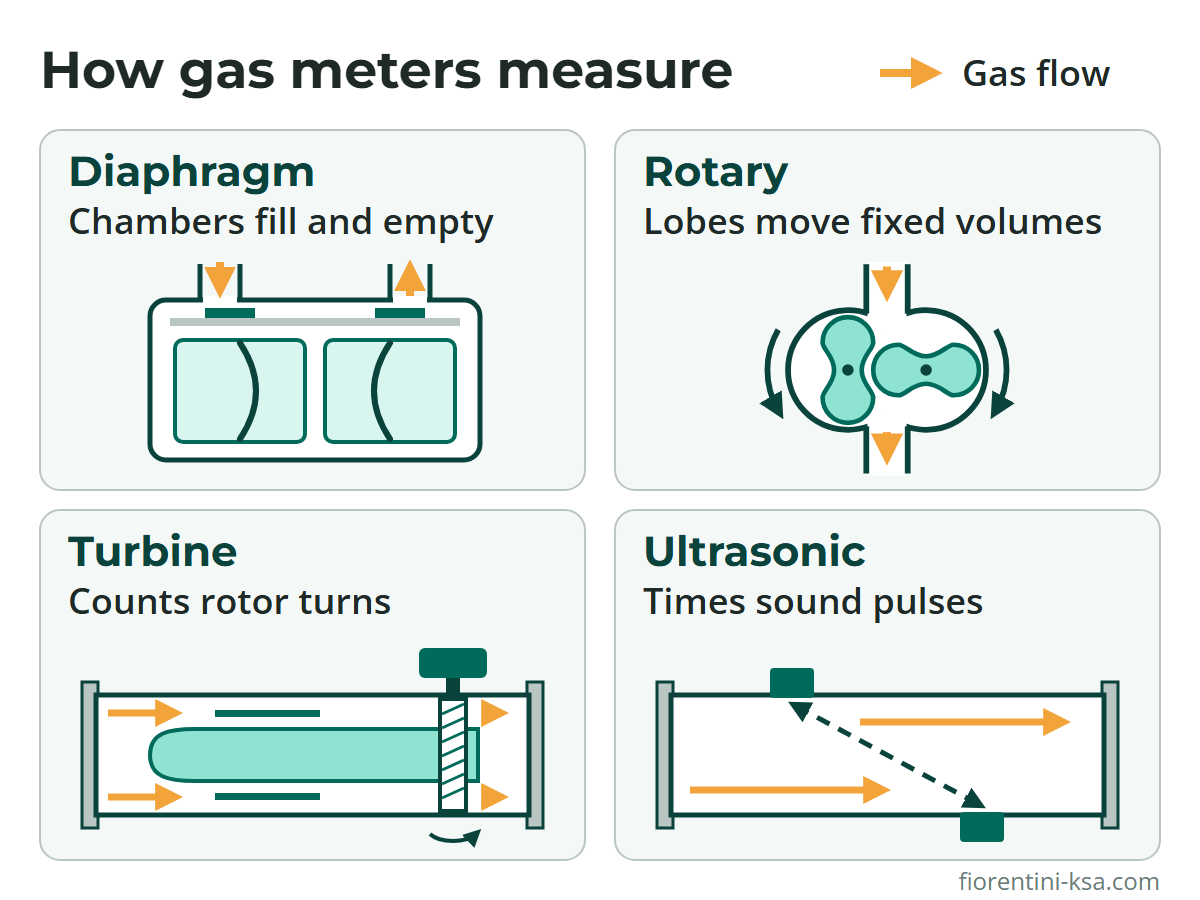
Four main types of gas meters cover the range from a home supply to a high-pressure transmission line: diaphragm, rotary, turbine and ultrasonic. Diaphragm and rotary meters are positive displacement meters that trap and count known volumes of gas. Turbine and ultrasonic meters are velocity meters that measure gas speed and derive the volume from it. This guide explains how each works, compares them and gives a selection checklist.
Key takeaways
- Diaphragm and rotary meters count fixed volumes; turbine and ultrasonic meters infer volume from gas velocity.
- Diaphragm meters suit low-pressure homes and shops, rotary meters medium flows, and turbine and industrial ultrasonic meters large flows, often at high pressure.
- Size meters in actual m³/h at operating pressure, not in standard m³/h.
- OIML R 137 sets accuracy classes 0.5, 1 and 1.5 for all gas meter types.
- Velocity meters need conditioned flow; mechanical meters need filtered gas.
In this article
How gas meters measure: displacement or velocity
A positive displacement meter splits the gas stream into fixed volumes and counts them. A velocity (inferential) meter measures gas speed instead and converts it into volume flow. That makes it sensitive to swirl and distorted velocity profiles. OIML R 137, the international recommendation for gas meters, therefore requires flow-disturbance tests for turbine and ultrasonic meters, but not for diaphragm or rotary meters.
All four measure volume at operating conditions, the actual pressure and temperature in the pipe. Billing normally uses base conditions, so a volume converter or built-in compensation converts the reading.
Key datasheet terms:
- Qmin, Qt and Qmax: the minimum, transitional and maximum flow rates. Permitted errors are wider between Qmin and Qt.
- Accuracy class: OIML R 137 defines classes 0.5, 1 and 1.5. At type approval and initial verification, class 1 allows ±2 % from Qmin to Qt and ±1 % from Qt to Qmax; class 1.5 allows ±3 % and ±1.5 %.
- Rangeability (turndown): the ratio Qmax/Qmin of one meter size.
How the four types of gas meters work
Pietro Fiorentini supplies all four types in its gas meter range.
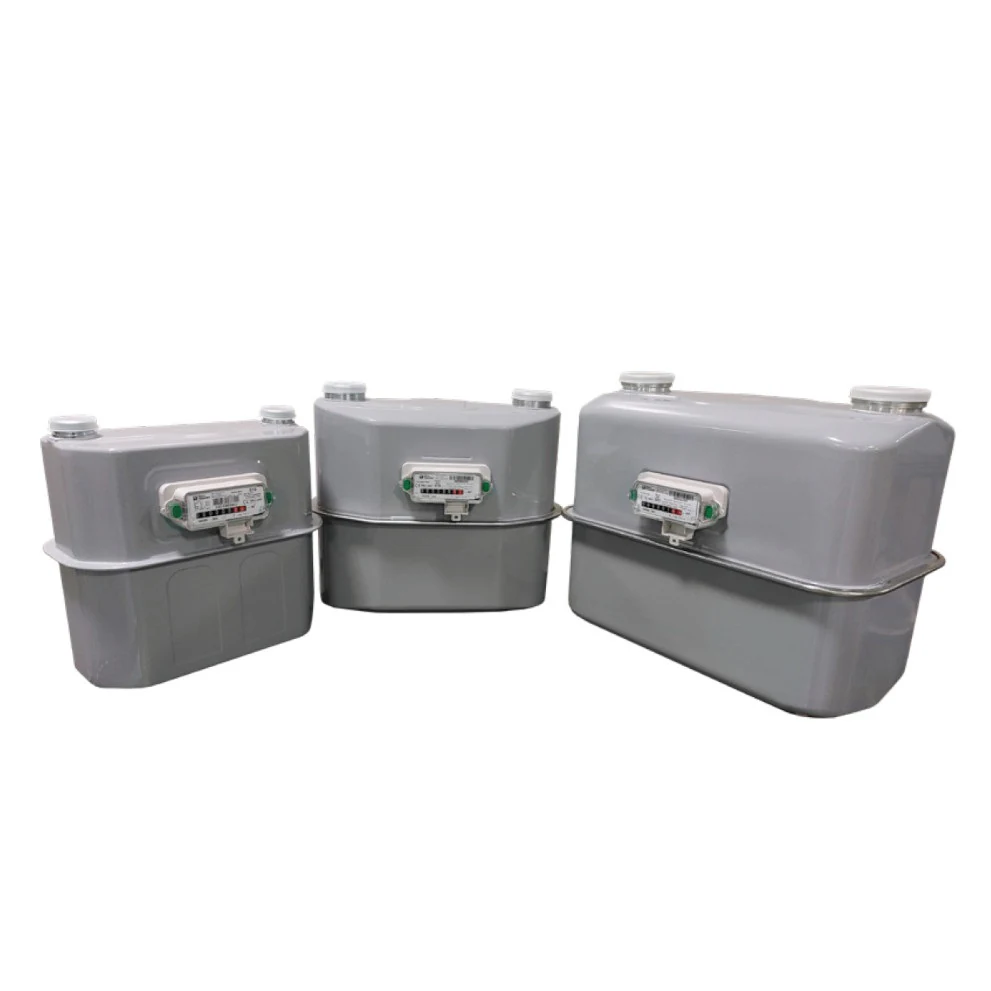
Diaphragm gas meters
A diaphragm meter has two measuring chambers, each with a flexible membrane. The pressure difference between inlet and outlet moves the membranes, and a distribution valve switches the chambers between filling and emptying. A linkage drives the counter. Each cycle passes a fixed cyclic volume, 2.0 dm³ in the RS 2.0 residential meter.
EN 1359 covers class 1.5 diaphragm meters up to 0.5 bar and 160 m³/h. Pietro Fiorentini's diaphragm gas meters run from size G1.6, starting at 0.016 m³/h, to G25. The MM covers G10 to G25, up to 40 m³/h, for commercial users.
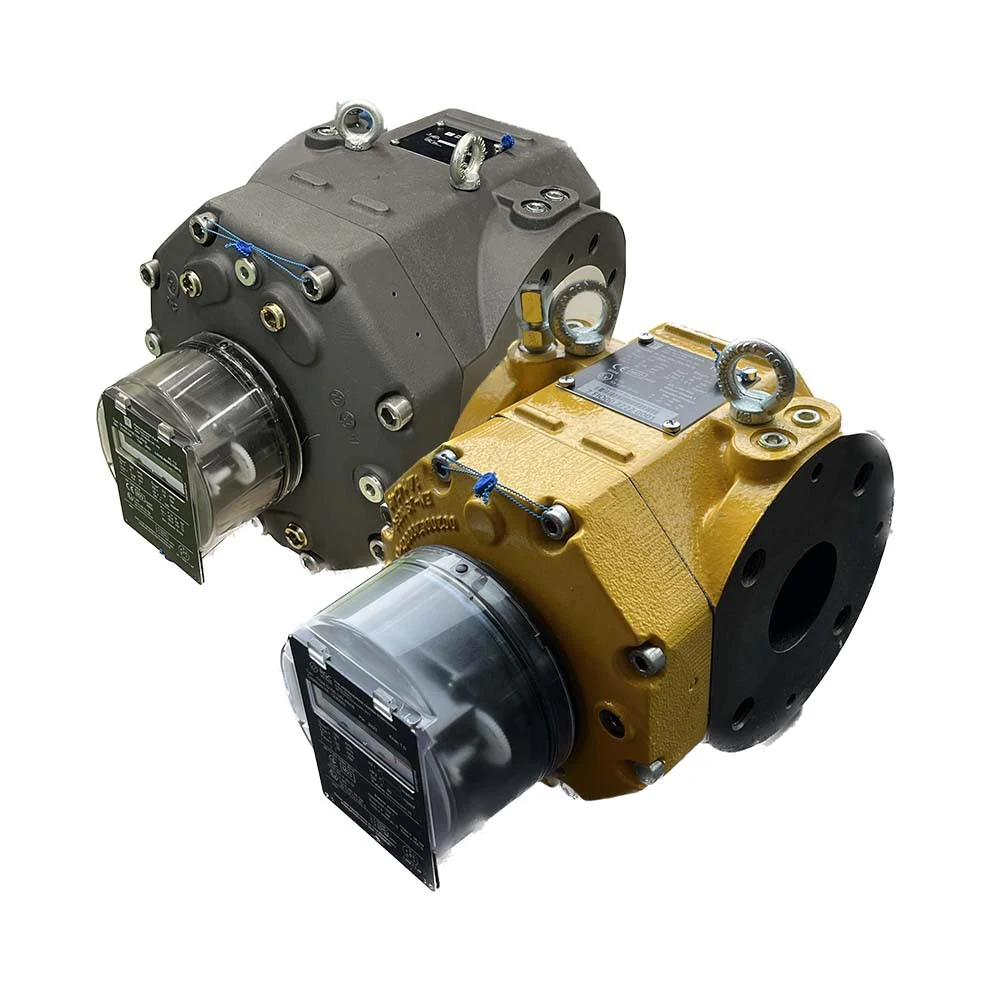
Rotary gas meters
A rotary meter has two figure-eight impellers that counter-rotate in a rigid chamber. Synchronizing gears hold them in step with small running clearances, so they never touch. Each revolution moves a fixed volume of gas through the meter.
The IM-RM, Pietro Fiorentini's rotary gas meter, covers 0.5 to 1,000 m³/h in 1½ to 6 inch sizes. Its design pressure is up to 25 bar(g), and standard rangeability runs from 1:30 to 1:200, depending on size. A jammed rotor blocks the flow, so Twin versions, offered in larger sizes, can include an automatic bypass.
Turbine gas meters
Gas passes a flow straightener and spins a bladed rotor. Rotor speed rises in proportion to gas velocity, and the index converts the revolutions into volume. OIML R 137 notes that every turbine meter needs a flow director (straightener and nose cone) in its upstream part.
The IM-TM, Pietro Fiorentini's turbine gas meter, has an integrated multi-stage flow conditioner. Its manual asks for at least two pipe diameters (2 DN) of straight pipe upstream and recommends 5 DN. It covers 8 to 6,500 m³/h in 2 to 12 inch sizes, and up to 100 bar with a steel body. Rangeability is up to 1:20, and an oil system keeps the bearings clean and lubricated.
Ultrasonic gas meters
Pairs of transducers send sound pulses across the pipe. Pulses traveling with the flow speed up and pulses against it slow down, and the transit-time difference gives the average gas velocity. AGA Report No. 9 defines multipath meters as having at least two independent acoustic paths, which reduces errors from distorted profiles and swirl. There are no moving parts, pressure loss is small, and the electronics report diagnostics such as speed of sound.
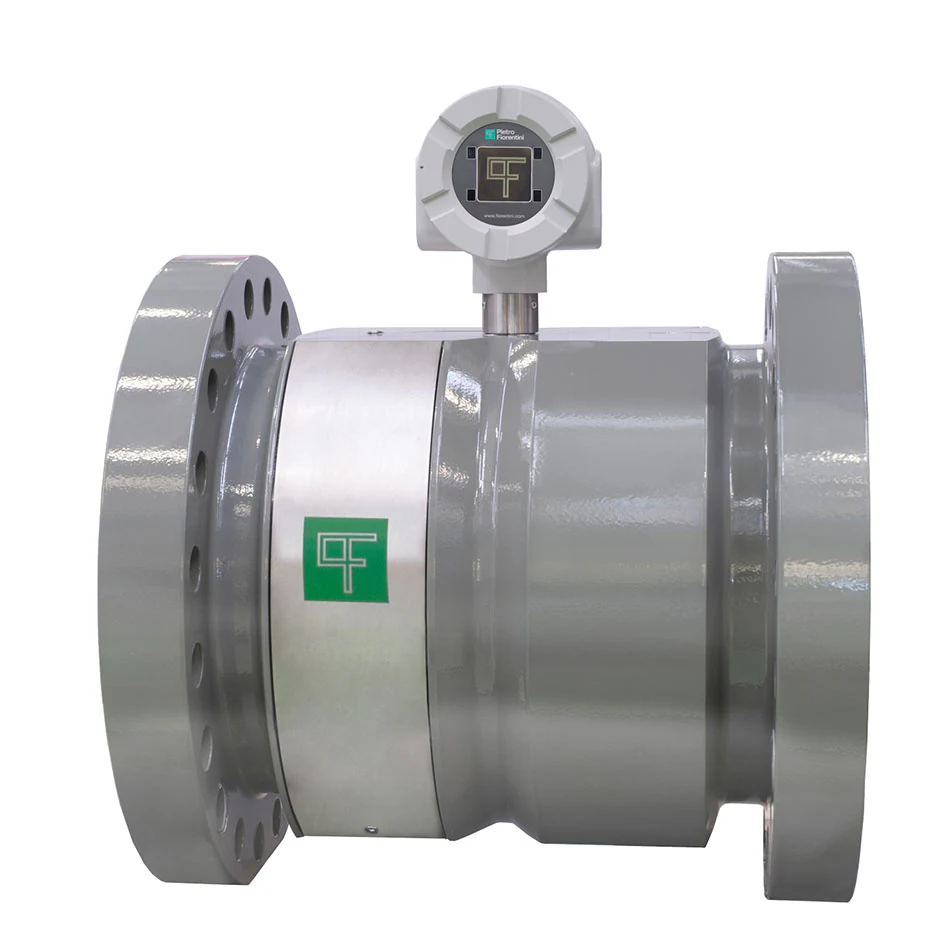
Pietro Fiorentini's ultrasonic gas meters include the multipath FioSonic, for 2 to 30 inch lines (DN 50–DN 750) in its three-path version and 3 to 30 inch in its four-path version, with a design pressure up to 153 bar(a). It measures 9 to over 40,000 m³/h in OIML class 0.5 or 1. The compact FioSonic Mini serves 3 and 4 inch distribution lines. Noise from regulators and control valves can disturb the signal, so plan the station layout around it; see the ultrasonic gas meter guide.
Other measuring principles
OIML R 137 also covers Coriolis, thermal mass and vortex gas meters, but not meters for multiphase flow, such as untreated well streams. Orifice meters (ISO 5167-2) derive flow from the differential pressure across a plate in the pipe.
Gas meter types compared
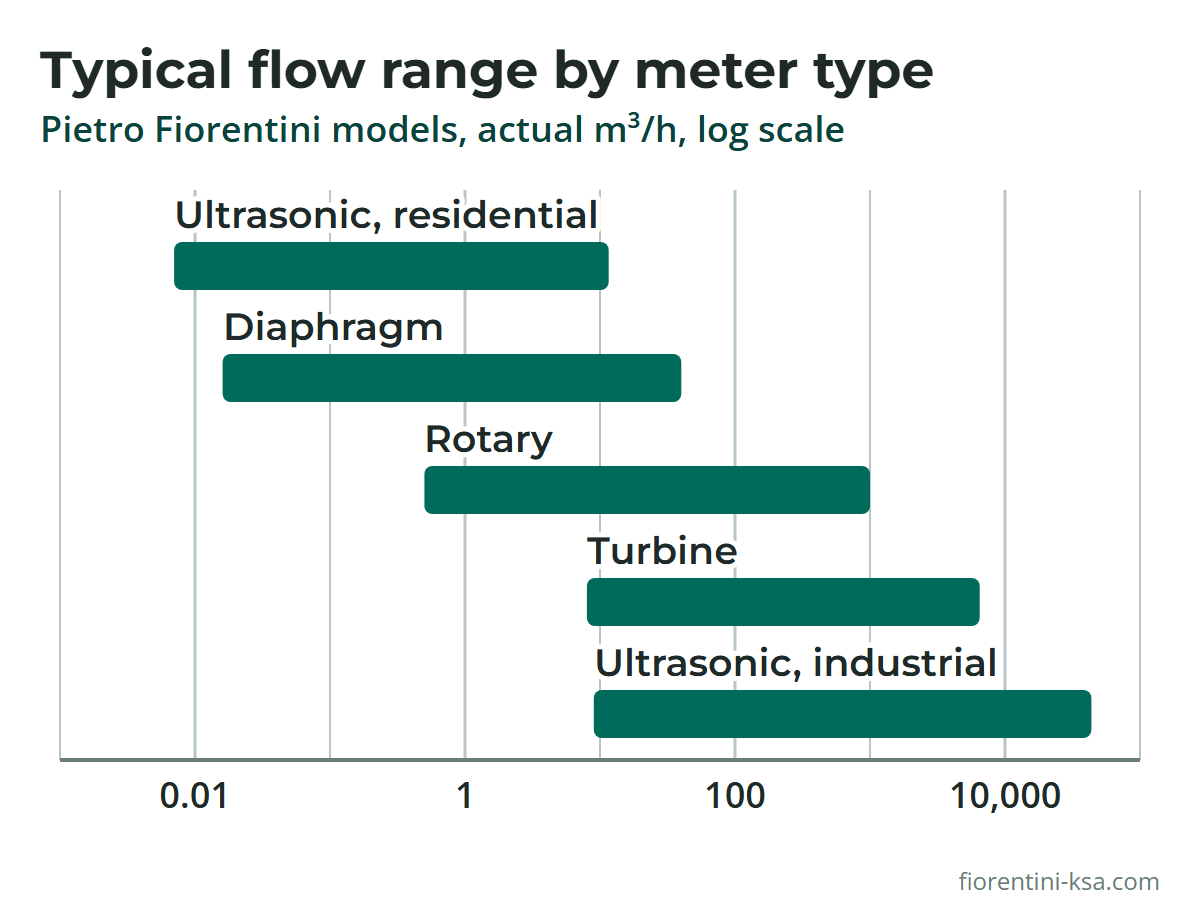
Values are examples from Pietro Fiorentini datasheets, with the industrial FioSonic for ultrasonic, and vary by model and size.
| Feature | Diaphragm | Rotary | Turbine | Ultrasonic |
|---|---|---|---|---|
| Principle | Displacement (chambers) | Displacement (impellers) | Velocity (rotor) | Velocity (sound pulses) |
| Typical applications | Homes, small commercial | Commercial, industry, city gates | Transmission, distribution, industry | Transmission, storage, custody transfer |
| Example flow range | 0.016–40 m³/h | 0.5–1,000 m³/h | 8–6,500 m³/h | 9 to over 40,000 m³/h |
| Example maximum pressure | 0.5 bar(g) | 25 bar(g) | 100 bar(g) | 153 bar(a) |
| Rangeability per size | 1:150 to 1:167 | 1:30 to 1:200 | Up to 1:20 | 1:66 to 1:100 |
| Example accuracy | Class 1.5 | ±1 % (Qt to Qmax) | ±1 % (Qt to Qmax) | Class 0.5 or 1 |
| Upstream flow profile | Low sensitivity | Low sensitivity | Conditioning needed | Conditioning needed |
| Moving parts | Yes | Yes | Yes | No |
Displacement meters offer wide rangeability at low and medium flows, while turbine and industrial ultrasonic meters handle large flows at high pressure. For the two middle options, see rotary vs turbine gas meters.
Where smart meters and volume converters fit
"Smart" describes the electronics, not the measuring principle. Pietro Fiorentini's smart gas meters use a diaphragm unit (HM, HM-iCON, RSE/RSV) or an ultrasonic one (SSM-iCON). They add remote communication, such as NB-IoT or GPRS, and, depending on the model, an electronic index or data logging.
EN 12405-1 covers electronic converters that correct volume for temperature (T), for pressure and temperature (PT), or also for compressibility (PTZ). Pietro Fiorentini's range runs from the two-channel Modus to the single-channel Modus Mini with its embedded NB-IoT/Cat-M1 modem. Some small meters correct internally, such as the temperature-compensated RST 2.0. The guide to smart gas meters and volume converters covers the equation and remote reading.
How to choose a gas meter
- Flow in actual m³/h. Check Qmax against peak demand at the lowest pressure, and Qmin against the lowest demand, such as night or seasonal lows, at the highest pressure. At 4 bar(g), one actual cubic meter holds about five cubic meters at base conditions (Boyle's law, before temperature and compressibility corrections).
- Pressure. Check the meter's rated pressure and flange class against the maximum line pressure. Diaphragm meters are low-pressure devices, so higher pressures need a rotary, turbine or ultrasonic meter.
- Accuracy and approvals. Set the class and the certificates the contract or local rules require, such as OIML R 137 or EU MID.
- Piping. Velocity meters need the straight pipe and flow conditioner set out by the manufacturer; displacement meters are far less sensitive to upstream fittings.
- Gas quality. Mechanical meters need filtered, dry gas. Declare any hydrogen blend.
- Pulsation and noise. Pulsations from compressors or fast-cycling regulators generally make turbine meters over-register (AGA Report No. 7), and valve noise can disturb ultrasonic meters.
- Outputs. Specify pulses, an encoder or Modbus to suit the converter, flow computer or SCADA system.
- Environment and upkeep. Match temperature and hazardous-area ratings to the site, and plan lubrication, diagnostics and reverification.
Gas meter standards
Product standards cover each type, and OIML R 137 sets accuracy classes and tests across all technologies. The IM-RM, IM-TM and FioSonic are also certified under the EU Measuring Instruments Directive 2014/32/EU (MID). Design pressure and standard scope differ: the IM-RM is designed for 25 bar(g), while EN 12480 covers working pressures up to 20 bar.
| Standard | Scope |
|---|---|
| EN 1359:2017 | Class 1.5 diaphragm meters up to 0.5 bar and 160 m³/h |
| EN 12480:2025 | Rotary displacement meters with mechanical index, up to 20 bar |
| EN 12261:2024 | Class 1.0 axial and radial turbine meters, up to 420 bar and 25,000 m³/h |
| ISO 17089-1:2019 | Transit-time ultrasonic meters for custody transfer and allocation, two accuracy classes |
| AGA Report No. 9 (2022) | Multipath ultrasonic meters for natural gas |
| OIML R 137-1&2:2012 | Gas meters of any technology: accuracy classes, permitted errors and tests |
| EN 12405-1:2021 | Electronic volume conversion devices: T, PT and PTZ |
Saudi Arabia and GCC considerations
- Heat. Saudi Arabia's Ministry of Environment, Water and Agriculture gives summer maximum temperatures of 35 to 45 °C, and direct sun heats equipment further. EN 1359 and EN 12480 require meters to work over at least −10 to +40 °C. Most meters in this guide are rated up to +55 °C, but the temperature-compensated RST 2.0 accepts gas only up to +40 °C. Shade or ventilated enclosures preserve a margin.
- Sand and dust. Inside the pipe, contaminated bearings degrade turbine performance, and the IM-TM manual rules out installation with dirt or welding residue present. Clean the inlet pipework and fit a gas filter: filters for low pressure are designed for up to 10 bar, with 5 or 50 micron elements depending on the model, and the HFA-HFB dry gas filter for up to 100 bar, with 5-micron filtration as standard. Outside, choose dust-tight indexes; the IM-RM and IM-TM indexes are rated IP67.
- Remote sites. Smart meters and converters with remote communication cut site visits. Confirm NB-IoT or GPRS coverage before specifying them.
How Pietro Fiorentini can help
Pietro Fiorentini Saudi Industry in Al Khobar supplies all four meter types, smart meters and volume converters, plus filters and gas pressure regulators for pressure reducing and metering stations (PRMS). Its services include engineering, installation and commissioning, automatic meter reading, spare parts and PF Gas Academy training.
Need help choosing a gas meter? Send us your flow range, operating pressure, gas composition and required accuracy, and our engineers will recommend a suitable meter. Contact our engineers.
Frequently asked questions
What are the main types of gas meters?
Four types cover gas networks from homes to transmission pipelines: diaphragm, rotary, turbine and ultrasonic. Diaphragm and rotary meters are positive displacement meters that count fixed volumes. Turbine and ultrasonic meters infer volume from gas velocity. Smart meters add electronics and remote reading to a measuring unit, which in Pietro Fiorentini's range is diaphragm or ultrasonic.
Which type of gas meter is the most accurate?
It depends on the accuracy class and the installation. OIML R 137 defines classes 0.5, 1 and 1.5; at type approval, class 0.5 allows ±0.5 % from Qt to Qmax. The FioSonic ultrasonic meter is available in class 0.5, the IM-RM and IM-TM work within class 1 limits, and EN 1359 diaphragm meters are class 1.5. Poor flow profiles, dirt or pulsation can degrade accuracy in service.
What does G4 or G25 mean on a gas meter?
It is the size designation, and each G-number corresponds to a maximum flow. In Pietro Fiorentini datasheets, a G4 meter covers 0.04 to 6 m³/h and a G25 meter 0.25 to 40 m³/h. Larger rotary and turbine sizes continue the series, such as G100 at 160 m³/h. Qmin varies by model, so check the datasheet.
Which type of gas meter suits a commercial or industrial site?
Shops and small businesses on low-pressure supplies typically use diaphragm meters, such as the MM up to 40 m³/h. Larger commercial and industrial loads suit rotary meters, such as the IM-RM, which covers 0.5 to 1,000 m³/h. Pietro Fiorentini aims its IM-TM turbine and FioSonic ultrasonic meters at heavy industry, power plants and high-pressure transmission.
Can gas meters measure hydrogen blends?
Many can, within stated limits. Pietro Fiorentini lists the FioSonic and FioSonic Mini for blends with up to 30 % hydrogen, and the SSM-iCON for up to 20 %. The IM-RM and IM-TM are hydrogen-ready, with dedicated 100 % hydrogen versions. Confirm the limit on the datasheet and the approval certificate.
References
- OIML R 137-1&2:2012 Gas meters, including Amendment 2014 – International Organization of Legal Metrology (OIML)
- EN 1359:2017 Gas meters – Diaphragm gas meters – Swedish Institute for Standards (SIS)
- EN 12480:2025 Gas meters – Rotary displacement gas meters – SIS
- EN 12261:2024 Gas meters – Turbine gas meters – SIS
- ISO 17089-1:2019 Ultrasonic meters for gas – Part 1: Meters for custody transfer and allocation measurement – ISO
- AGA Report No. 9: Measurement of Gas by Multipath Ultrasonic Meters (2022) – American Gas Association