

A smart gas meter measures gas like any meter, but its electronics also store readings, raise alarms and send data to the utility. A volume converter solves a different problem. Gas is compressible, so a cubic meter at line pressure and temperature is not the cubic meter on the invoice. The converter measures temperature, and usually pressure, and recalculates the volume at agreed base conditions.
Key takeaways
- Billing uses volume at base conditions, not the volume measured in the pipe.
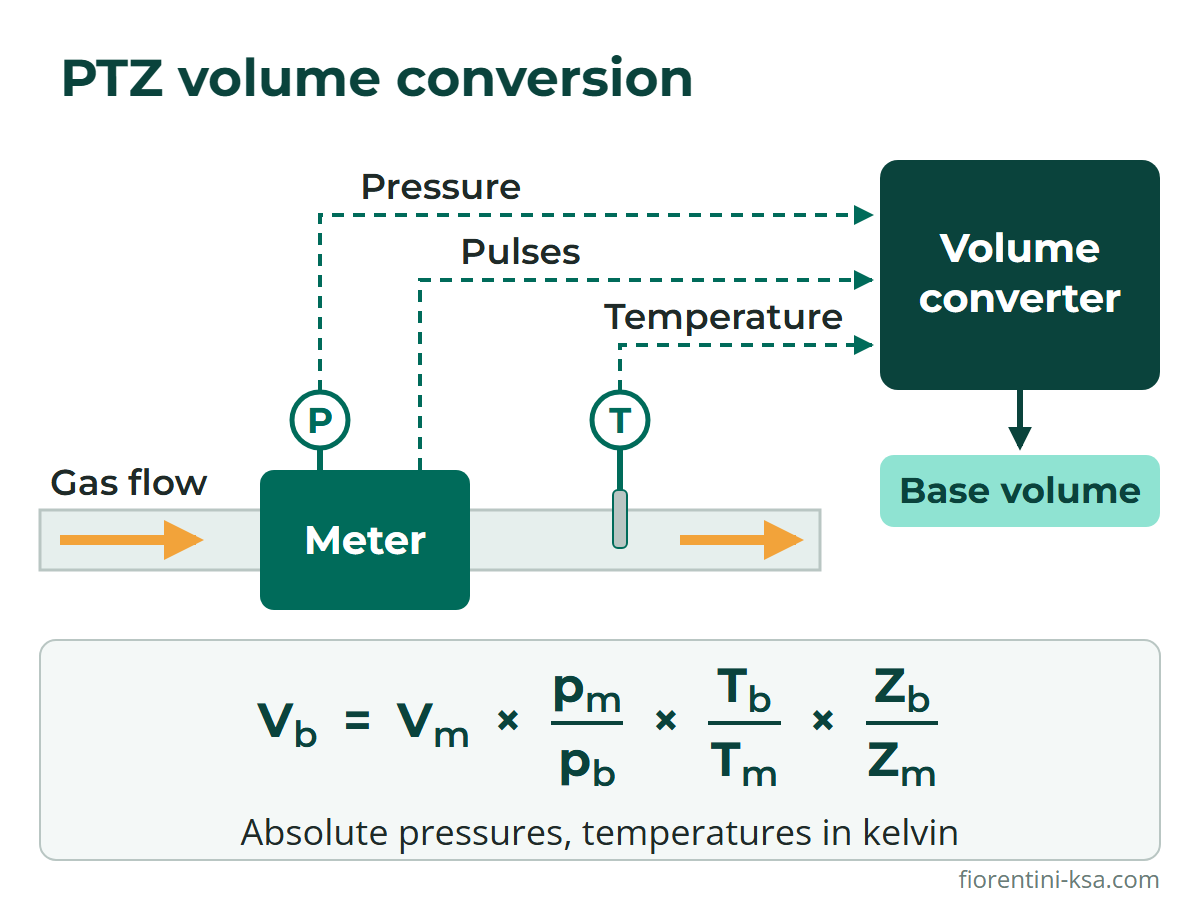
- A PTZ volume converter applies Vb = Vm × (pm/pb) × (Tb/Tm) × (Zb/Zm) from measured pressure and temperature.
- EN 12405-1 covers T, PT and PTZ conversion; the compressibility correction grows with pressure.
- A smart gas meter adds an electronic index, data logging, alarms, remote communication and, on some models, a shut-off valve.
- Specify base conditions, network coverage, data security and temperature ratings.
In this article
Why measured gas volume must be converted
A gas meter measures volume at metering conditions, the pressure and temperature of the gas inside it. Billing uses volume at base conditions, the specified reference pressure and temperature to which the measured volume is converted. Where gas is sold by energy, that base volume is multiplied by the calorific value.
OIML R 140 notes that some ISO standards prefer 101.325 kPa and 288.15 K (15 °C). AGA Report No. 9 gives 14.73 psia and 60 °F as typical US values. The introduction to ISO 13443 warns that unrecognized differences in reference conditions can have serious consequences in custody transfer, so confirm them in the contract.
The conversion follows the real-gas law:
Vb = Vm × (pm / pb) × (Tb / Tm) × (Zb / Zm)
- Vm, Vb: volume at metering conditions and at base conditions.
- pm, pb: absolute pressures, so add atmospheric pressure to a gauge reading.
- Tm, Tb: absolute temperatures in kelvin (°C + 273.15).
- Zm, Zb: compression factors, which describe how far the gas deviates from an ideal gas.
The product of the three ratios is the conversion factor. As an illustrative example, convert 1,000 m³ of pure methane metered at 5 bar(g) and 30 °C to 1.01325 bar(a) and 15 °C. Methane data from the NIST Chemistry WebBook give Zm ≈ 0.990 and Zb ≈ 0.998.
| Correction | Ratio | Factor (illustrative) |
|---|---|---|
| Pressure | 6.013 / 1.013 bar(a) | 5.935 |
| Temperature | 288.15 / 303.15 K | 0.951 |
| Compressibility | 0.998 / 0.990 | 1.008 |
| Conversion factor | Product of the three | 5.685 |
The converter registers about 5,685 m³ at base conditions. Ignoring temperature would overstate this by about 5 %, and ignoring Z would understate it by about 0.8 %. For the same methane at 40 bar(g) and 30 °C, Zm falls to about 0.936 and the Z ratio rises to about 1.066.
T, PT and PTZ gas volume converters
EN 12405-1:2021 is the European standard for electronic gas volume conversion devices. It covers three kinds of conversion: T (temperature only), PT (pressure and temperature, constant compression factor) and PTZ (compression factor also calculated). A converter is a calculator with a temperature transducer, plus a pressure transducer for PT and PTZ. At the manufacturer's choice, it is treated as one complete instrument (Type 1) or as separate elements (Type 2).
| Type | Measured | Fixed in the calculation | Typical fit (general guidance) |
|---|---|---|---|
| T | Temperature | Pressure and Z ratio | Low, stable supply pressure |
| PT | Pressure, temperature | Z ratio | Moderate pressures, Z near 1 |
| PTZ | Pressure, temperature | Gas quality data for Z | Higher pressures, large users |
For PTZ conversion, the converter calculates Z from gas quality data, which can be preset at installation. EN 12405-1 references two methods: ISO 12213-2 uses the detailed molar composition, and ISO 12213-3 uses calorific value, relative density and CO2 content. Both state an uncertainty of about ±0.1 % for pipeline-quality gas. Z depends on the gas composition, so update the inputs when the supply changes.
Annex MI-002 of the EU Measuring Instruments Directive (MID) covers gas meters and converters for residential, commercial and light-industrial use. It limits the converter's own error to 0.5 % at reference conditions, and to 1 % (0.7 % for T devices) at rated operating conditions, excluding the meter's error. The converter must also detect operation outside its stated ranges, stop integrating the converted volume and may total it in a separate register.
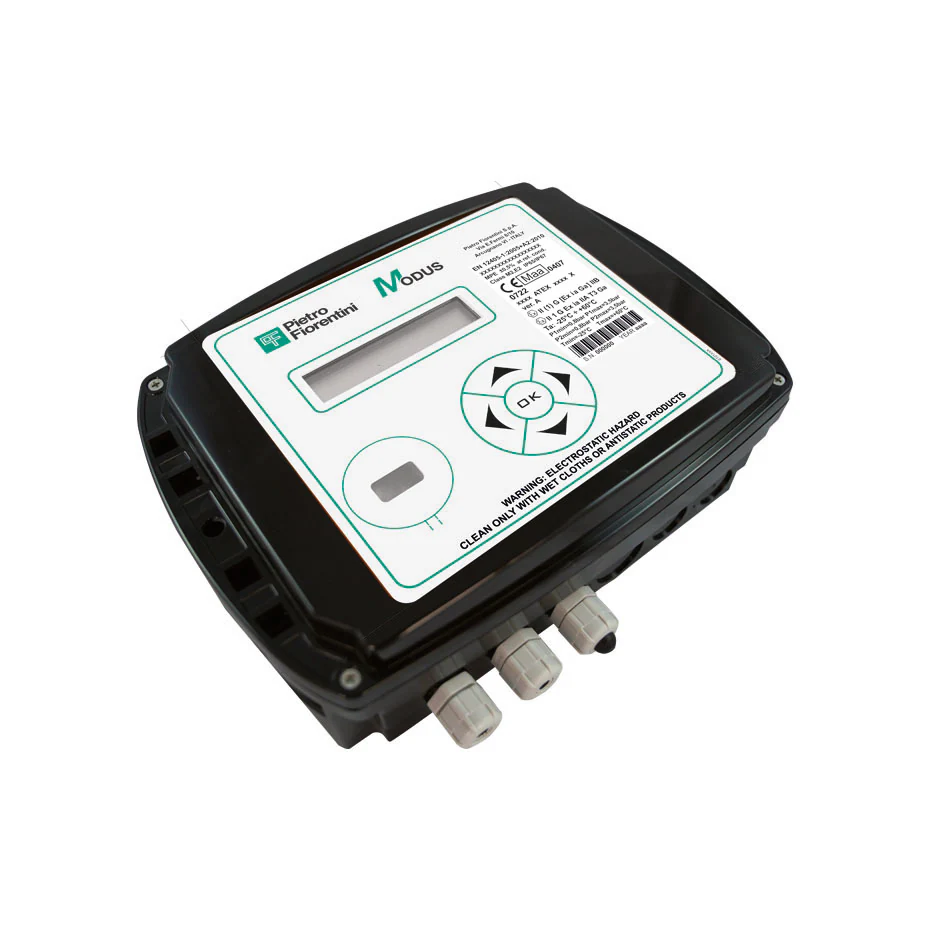
Pietro Fiorentini's volume converters are MID certified. Modus and Modus Slim2 are suitable for ATEX Zone 0, where an explosive gas atmosphere is present continuously, for long periods or frequently. Modus handles up to two PTZ channels, each with meter pulses, pressure and temperature. It reports to SCADA (supervisory control and data acquisition) systems over Modbus or UNI TS 11291-3 (CTR). Its flyer lists Z methods to ISO 12213-2, ISO 12213-3 and AGA-NX19.
Modus Slim2 is a compact PTZ converter with integrated pressure and temperature sensors. The single-channel Modus Mini has an embedded NB-IoT/Cat-M1 modem and a 15-year metrology battery, and is certified for ATEX Zone 1 (II 2G Ex ib IIC T4 Gb) rather than Zone 0. Converters take pulses from meters such as rotary and turbine meters; the comparison of rotary vs turbine gas meters explains that choice.
What makes a smart gas meter smart
A smart gas meter still has a measuring unit, such as the diaphragm or ultrasonic units described in types of gas meters; the difference is the electronics. In Europe, EN 16314 covers battery-powered "additional functionalities" on meters up to 40 m³/h and 500 mbar. It includes electronic indexes, and integral valves on meters up to 10 m³/h. Typical functions are:
- Electronic index and data logging: consumption stored over time, not just a running total.
- Remote communication: readings and alarms sent over a cellular or radio network.
- Diagnostics and tamper detection: faults and fraud attempts recorded and reported.
- Shut-off valve: closes on a remote command or a local safety event.
- Firmware updates: new software installed over the air.
- Built-in conversion: some meters convert to base conditions themselves.
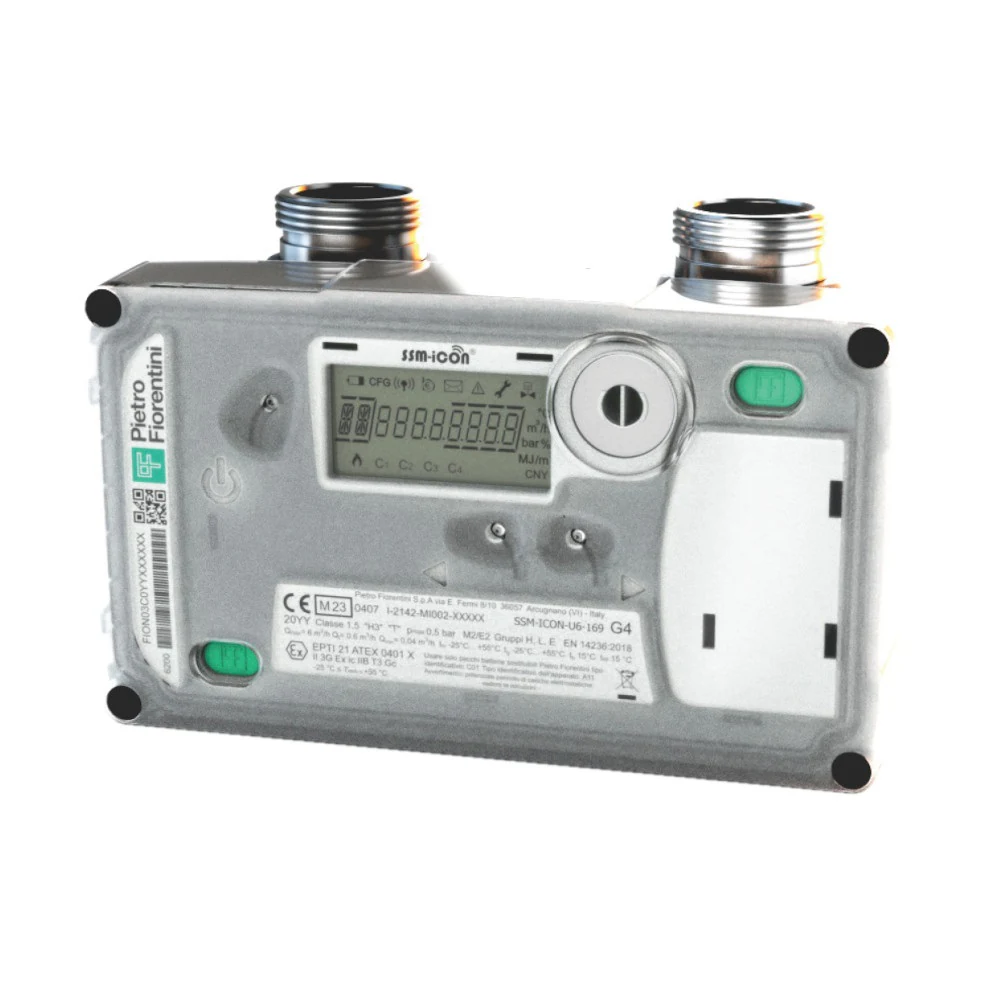
Pietro Fiorentini's smart gas meters combine them differently. The HM-iCON is a MID-approved meter with internal pressure and temperature sensors for PT conversion, set at the factory, and it displays base-condition volume only. The SSM-iCON has a valve that can be closed remotely or locally on specific events, such as exceeding a temperature threshold. The RSE/RSV adds anti-tampering and an optional integrated valve for remote supply control and prepayment.
| Model | Measuring unit | Qmax by size | Communication | Notable functions |
|---|---|---|---|---|
| SSM-iCON | Ultrasonic | 6 m³/h | GPRS, NB-IoT, Wireless M-Bus | Event-triggered valve |
| SSM-iCON 250 / 400 | Ultrasonic | 7.1 / 11.6 m³/h | NB-IoT and Cat-M1 module | Shutoff on temperature, pressure or seismic events |
| RSE/RSV | Diaphragm | Up to 10 m³/h | GPRS, NB-IoT, Wireless M-Bus | Anti-tampering, optional valve |
| HM | Diaphragm | 16–40 m³/h | GSM/GPRS | T and P sensors, remote firmware upgrade |
| HM-iCON | Diaphragm | 16–40 m³/h | NB-IoT, GPRS | PT conversion, leak and anomaly alerts |
Remote gas meter reading: AMR, AMI and networks
In its electricity meter survey, the US Energy Information Administration defines automated meter reading (AMR) as one-way transfer of billing data, usually from customer to utility. Advanced metering infrastructure (AMI) records usage at least hourly, delivers it at least daily and extends to two-way communication. Two-way links allow remote valve commands, configuration changes and firmware updates.
The product pages list three groups of networks:
- Cellular IoT: NB-IoT and LTE-M (Cat-M1), low-power technologies standardized by 3GPP in Release 13 for licensed mobile spectrum.
- 2G cellular: GSM/GPRS, offered on several meters and on Modus.
- Wireless M-Bus: unlicensed radio to EN 13757-4 for walk-by, drive-by or fixed-network reading, here at 169 MHz or 868 MHz.
The application protocol must also match the utility's systems. The RSE/RSV and SSM-iCON support the DLMS smart metering protocol and UNI/TS 11291, a specification developed for the Italian market. Modus uses Modbus or UNI TS 11291-3. Confirm coverage at the actual meter location, and the planned lifetime of the network, with the operator. The SSM-iCON 400 and 250 use a replaceable module, so the network can be changed in the field.
Meter data integration, quality and security
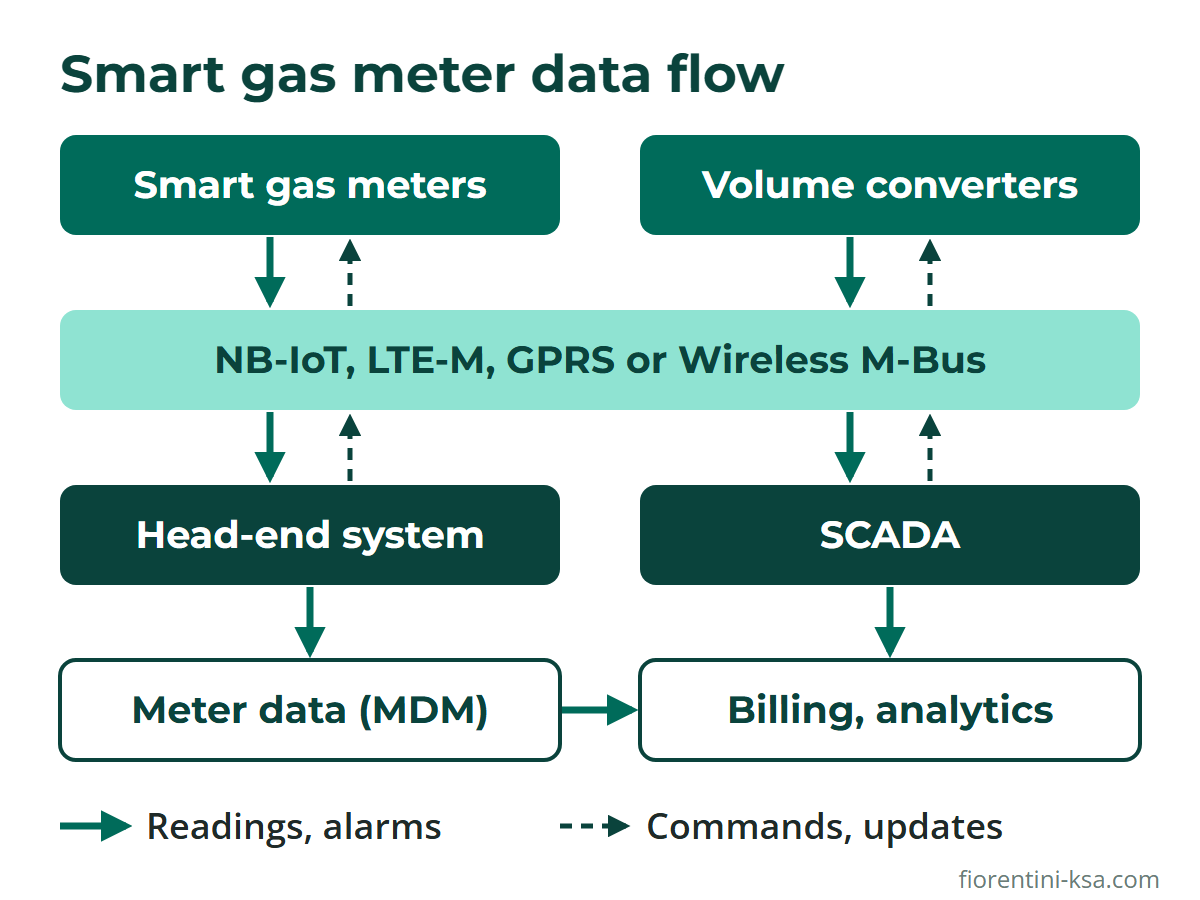
In a typical architecture, a head-end system collects data from the network. A meter data management (MDM) system validates and stores it, and the billing system invoices from it. Station converters such as Modus report to SCADA or a central data collection system. Data quality depends on a few basics:
- Time: keep device clocks synchronized so interval data line up.
- Completeness: monitor missing intervals and communication failures.
- Validity: check alarm logs, out-of-range registers and the audit trail of volumes, pressures, temperatures and parameters that OIML R 140 describes.
- Consistency: compare a district station's converted volume with the sum of its customer meters to find losses or faulty meters.
Remote valves and firmware updates make security a safety matter. The GSMA notes that authentication is mandatory on NB-IoT and LTE-M but user-data encryption is optional, so specify encryption explicitly, preferably end to end. Restrict who can send valve commands and log every command.
For firmware, WELMEC Guide 7.2, the software guide for MID instruments, treats software download as an attack vector. Its checks confirm that a download cannot alter parameters or the evidence of an intervention.
Saudi Arabia and GCC considerations
- Heat. The Ministry of Environment, Water and Agriculture gives summer temperatures of 35 to 45 °C. At the same pressure, gas at 35 °C occupies about 7 % more volume than at 15 °C, so temperature conversion matters. The smart meters above are rated to +55 °C ambient and Modus to +60 °C, so keep a margin with shade or ventilated cabinets. AGA Report No. 9 also warns that heat from the sun and the piping must not influence the temperature reading.
- Altitude. A T converter uses a fixed pressure value, so set it for the site's supply pressure and altitude. In NASA's Earth atmosphere model, atmospheric pressure at 600 m is about 0.944 bar, almost 7 % below 1.01325 bar.
- Dust. The SSM-iCON brochure credits its static ultrasonic design with high performance against dust contamination. It lists IP55 as standard, or IP66 on request. Check enclosure ratings, such as IP65/IP67 for Modus and IP66 for Modus Slim2.
- Remote sites. The Modus flyer gives a battery life of five years with one daily communication. For always-on communication, its MPower barrier can be supplied from mains, solar panels or microturbines.
How Pietro Fiorentini can help
Pietro Fiorentini Saudi Industry supplies smart gas meters, Modus, Modus Slim2 and Modus Mini converters, and the turbine, rotary and ultrasonic meters they work with. Its services cover engineering, installation and commissioning, automatic meter reading and remote management systems, and PF Gas Academy training. For complete metering stations, see the guide to gas pressure reducing and metering stations and the pressure reducing and metering stations (PRMS) that Pietro Fiorentini Saudi Industry supplies.
Planning a smart metering or volume conversion project? Send us your pressures, flow rates and communication needs, and our engineers will help you choose meters and converters. Contact our engineers.
Frequently asked questions
What is a smart gas meter?
A smart gas meter has an electronic index that stores consumption data and sends it to the utility over a communication network. Depending on the model, it also logs alarms and tampering, accepts firmware updates and can close a built-in valve. It usually measures with a diaphragm or ultrasonic unit.
What does a gas volume converter do?
A volume converter turns the volume measured at line pressure and temperature into volume at base conditions, which billing uses. A PTZ converter counts meter pulses, measures pressure and temperature, calculates Z and applies Vb = Vm × (pm/pb) × (Tb/Tm) × (Zb/Zm). T and PT devices use fixed values for the terms they do not measure. EN 12405-1 covers all three.
What is the difference between AMR and AMI?
In the US Energy Information Administration's definitions for electricity meters, automated meter reading (AMR) sends billing data one way, usually from customer to utility. Advanced metering infrastructure (AMI) records usage at least hourly, delivers it at least daily and can communicate both ways, which allows remote valve control and firmware updates.
Can a smart gas meter shut off the gas supply?
Some can. The SSM-iCON closes its valve on remote command or on specific events, such as a temperature threshold being exceeded. The SSM-iCON 250 and 400 add shut-off on temperature, pressure or seismic events, and also close on remote command. The RSE/RSV offers an optional integrated valve.
How long do smart gas meter batteries last?
It depends on the model and how often it communicates. The SSM-iCON brochure gives 15 years for the metrological battery, or 20 in the extended-life version. Its replaceable communication battery lasts up to 20 years, depending on the radio. In the EU, MID requires a dedicated power source to last at least five years and to warn after 90 % of its life.
References
- EN 12405-1:2021 Gas meters – Conversion devices – Part 1: Volume conversion – Swedish Institute for Standards (SIS)
- OIML R 140:2007 Measuring systems for gaseous fuel – International Organization of Legal Metrology (OIML)
- Directive 2014/32/EU on measuring instruments (MID), Annex IV MI-002 – European Union
- AGA Report No. 9: Measurement of Gas by Multipath Ultrasonic Meters, 2007 edition – American Gas Association, via Public.Resource.Org
- EN 16314:2013 Gas meters – Additional functionalities – Swedish Institute for Standards (SIS)
- Form EIA-861 instructions, AMR and AMI definitions – US Energy Information Administration