

A gas pressure regulator is a self-operated valve that reduces a higher, often variable inlet pressure to a lower, stable outlet pressure as downstream demand changes. Most need no external power: the gas itself moves the valve. Regulators sit at every pressure step of a natural gas system, from the city gate on a transmission line to the governor feeding a factory burner. This guide covers how they work, the main types, EN 334 datasheet terms, selection and maintenance, with notes for Saudi Arabia and the GCC.
Key takeaways
- A regulator balances outlet pressure on a diaphragm against a spring or a pilot-set loading pressure to hold its set point.
- Direct-operated designs are simple and fast; pilot-operated designs hold the set point more closely as flow changes.
- In EN 334 terms, AC is the accuracy class, SG the lock-up pressure class and Cg the flow coefficient used for sizing.
- Size at the lowest inlet pressure and the highest flow.
- In hot, dusty sites, plan upstream filtration, shading and regular checks of filters, pilots and vents.
In this article
How a gas pressure regulator works
Every gas pressure regulator combines three functional elements:
- Sensing element: usually a diaphragm exposed to the outlet pressure.
- Loading element: a spring, or a loading pressure set by a pilot, pushing against the diaphragm. Its force defines the set point, the outlet pressure the regulator is adjusted to hold.
- Control element: the valve plug (obturator) and seat that throttle the gas.
In a direct-operated regulator the spring pushes the valve open and outlet pressure under the diaphragm pushes it closed. When demand rises, outlet pressure dips slightly and the valve opens further. When demand falls, the plug moves back toward the seat. At zero flow the plug seals on the seat, and the outlet settles at the lock-up pressure, slightly above the set point.
Outlet pressure reaches the diaphragm through an internal passage or an external sensing line from the downstream pipe. The spring chamber above the diaphragm is vented to atmosphere.

Many station regulators are also balanced: the design compensates the inlet-pressure force on the plug, so inlet changes barely affect the outlet pressure.
Types of gas pressure regulators
Direct-operated regulators
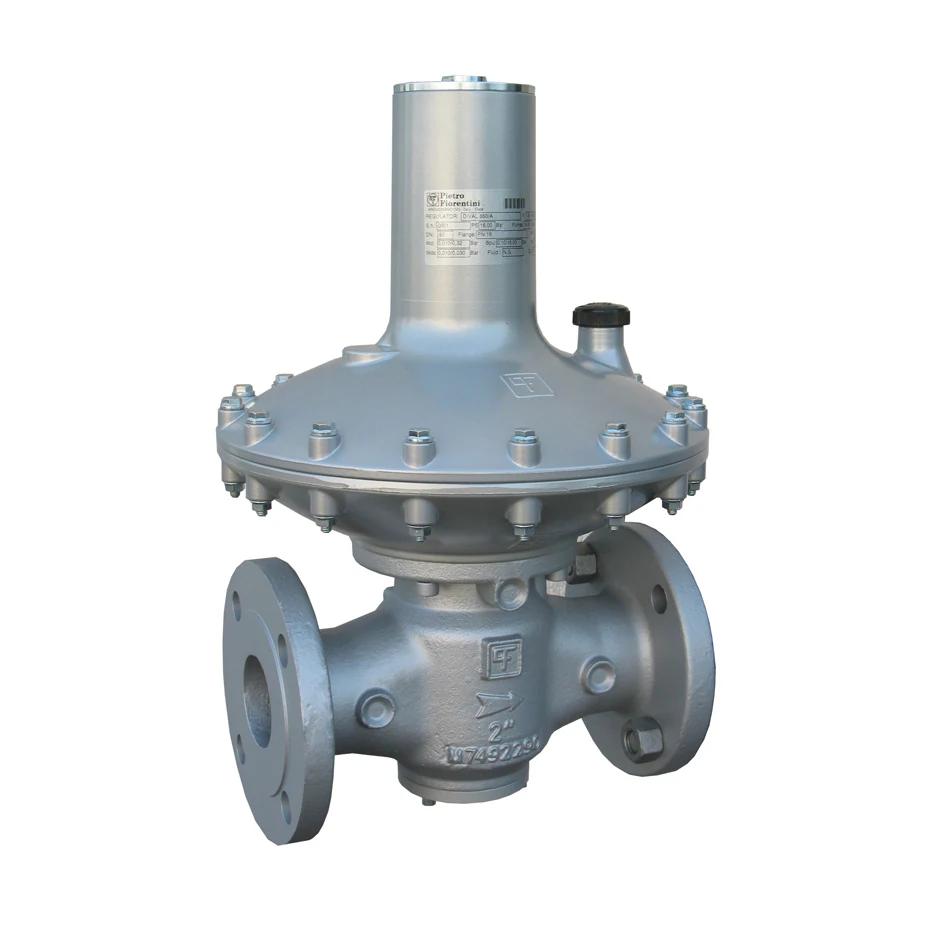
Direct-operated (spring-loaded) regulators have few parts and respond quickly. They suit district stations, commercial users and smaller industrial supplies. Their main limitation is droop, the fall in outlet pressure as flow rises. As the valve opens, the spring extends and pushes less, so the outlet settles lower. The Dival 600 is one example, with outlet pressures from 12 to 4,200 mbar, inlet pressures up to 20 bar and accuracy up to AC 5.
Pilot-operated regulators
In a pilot-operated design, a small pilot regulator senses the outlet pressure and adjusts the loading pressure on the main diaphragm. A small drop in outlet pressure produces a large change in loading pressure, so the main valve can travel its full stroke with little deviation from the set point. That suits city gates, transmission and large industrial loads. The Reflux 819 covers inlet pressures from 0.8 to 100 bar and outlet pressures from 0.3 to 74 bar. It comes in sizes from 1 to 12 inches, with accuracy up to AC 1. For a detailed comparison, see pilot-operated vs direct-operated gas regulators.
Low-pressure regulators and governors
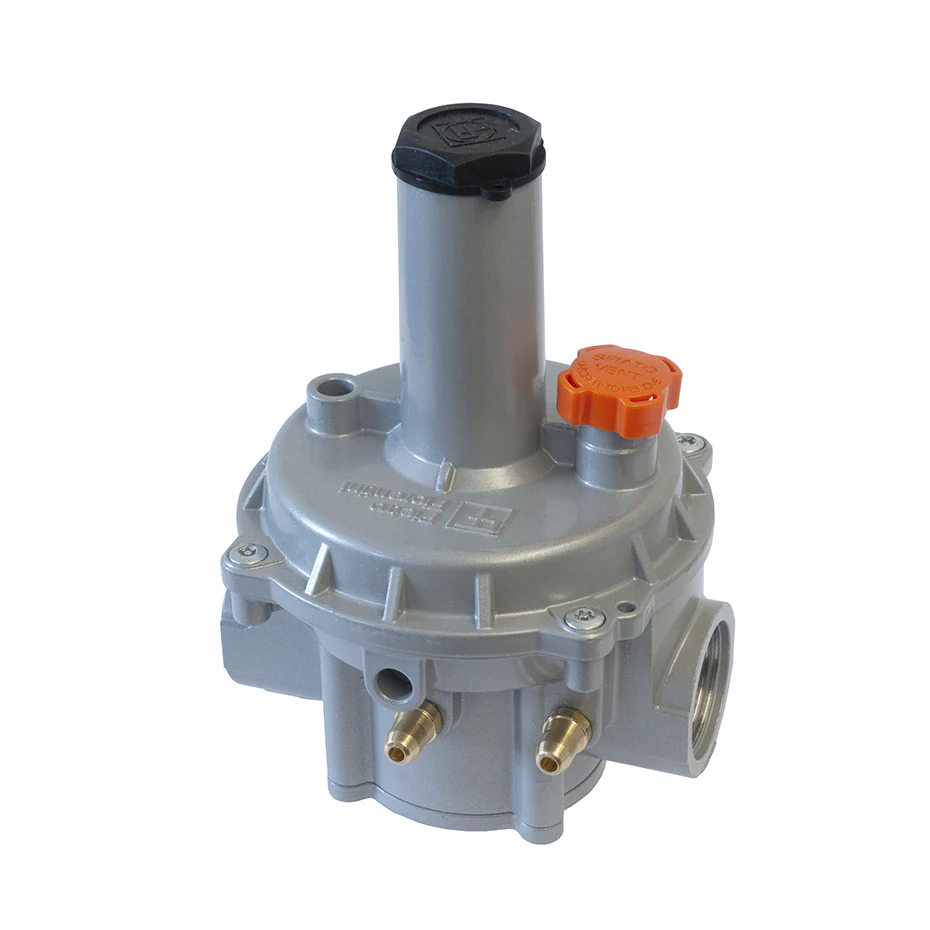
Near the end user, pressure drops to the millibar range. Service regulators such as the FE, a two-stage unit with an integrated over-pressure shut-off (OPSO), supply residential and commercial users. Governors feed burners and low-pressure networks. The Governors STD series has a double safety diaphragm and a balanced plug, accepts inlet pressures up to 500 mbar and delivers 5 to 300 mbar. It complies with EN 88-1, the standard for pressure regulators used with gas burners and gas-burning appliances at inlet pressures up to 50 kPa (500 mbar). EN 334 excludes regulators covered by EN 88-1.
Fail-open and fail-close regulators
EN 334 classifies regulators as fail-close or fail-open by how they react to specified, reasonably expected failures. A fail-close regulator closes and stops the supply. A fail-open regulator opens: Pietro Fiorentini's Aperval 101, for example, opens on loss of pilot supply or damage to the main pilot diaphragm. Station protection is covered in the guide to slam-shut, monitor and relief valves.
| Feature | Direct-operated | Pilot-operated | Governor |
|---|---|---|---|
| Loading element | Spring | Pilot-set loading pressure | Spring |
| Typical use | District stations, commercial users | City gates, transmission, large industry | Burners, low-pressure networks |
| Example accuracy | Up to AC 5 (Dival 600) | Up to AC 1 (Reflux 819) | AC 15 (Governors STD) |
| Watch-outs | Droop at high flow | Pilot circuit needs clean, dry gas | Inlet limited to 500 mbar (Governors STD) |
Pressure classes and network stages
Pietro Fiorentini groups its regulators into three pressure classes that match the network stages:
- High–medium pressure regulators for transmission lines, city gates and large industrial users.
- Medium–low pressure regulators for distribution networks and district stations.
- Low-pressure regulators and governors for end users, in the millibar range.
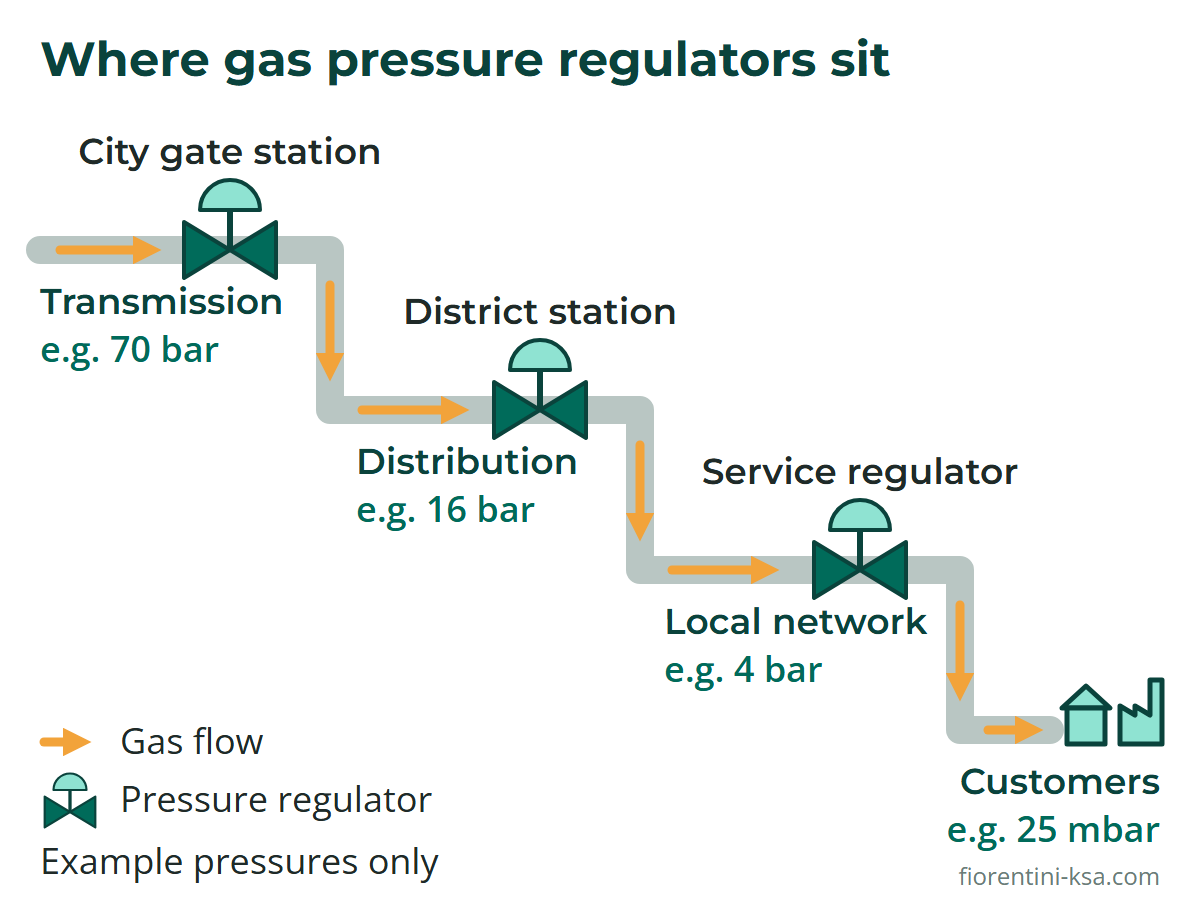
A city gate station takes gas from the transmission pipeline, and a district station feeds the local network. A service regulator or governor then sets the final supply pressure. Large industrial customers often have their own regulating and metering station. The meters used in these stations are compared in the guide to types of gas meters.
EN 12186:2025 sets functional requirements for gas pressure control stations with a maximum upstream operating pressure up to 100 bar. Smaller installations on service lines fall under EN 12279 instead. Filters, preheaters, meters and other station components are covered in the gas pressure reducing and metering station guide.
Gas pressure regulator performance terms
Regulator datasheets use symbols defined in EN 334:
| Term | Symbol | Meaning | Why it matters |
|---|---|---|---|
| Outlet pressure range | Wd | Range of possible set points | The set point must fall inside the spring or pilot range |
| Inlet pressure range | bpu | Inlet pressures with declared performance | Must cover the lowest and highest inlet pressure |
| Minimum differential pressure | Δp min | Smallest inlet-outlet difference that still allows control | Limits operation when inlet pressure falls |
| Accuracy class | AC | Maximum deviation of outlet pressure from the set point, in % of set point | AC 5 means within ±5 % under declared conditions |
| Lock-up pressure class | SG | Maximum rise above the set point at zero flow, in % of set point | Protects downstream equipment at zero demand |
| Flow coefficient | Cg | Capacity coefficient defined in EN 334 and used for sizing | Sets the size needed for peak flow |
Pietro Fiorentini's brochures calculate the fully open capacity for natural gas (relative density 0.61) from Cg and the form factor K1, as indicated by EN 334:
- Critical flow (Pu ≥ 2 × Pd): Q = 0.526 × Cg × Pu
- Sub-critical flow (Pu < 2 × Pd): Q = 0.526 × Cg × Pu × sin(K1 × √((Pu − Pd) / Pu)), with the sine in degrees
Q is the flow in Stm³/h (15 °C, 1 bar absolute), Pu and Pd are the absolute inlet and outlet pressures in bar, and K1 comes from the regulator's datasheet. As an illustration only, Cg = 2,000 with 21 bar absolute inlet and 6 bar absolute outlet is critical flow, giving about 0.526 × 2,000 × 21 ≈ 22,100 Stm³/h fully open. With an in-line monitor upstream, Pietro Fiorentini suggests reducing the active regulator's Cg by about 20 %. Always size with the manufacturer's data or software.
Specifications also quote turndown, the ratio of maximum usable flow to minimum controllable flow; a high turndown covers both peak and night-time demand.
How to choose a gas pressure regulator
Natural gas regulator selection starts with data:
- Inlet pressure. The maximum sets the design pressure and flange rating. The minimum sets the size, since capacity is lowest at minimum inlet pressure.
- Set point and tolerance. Choose a spring or pilot range that contains the set point, and the AC and SG classes the downstream equipment needs.
- Flow range. State peak and minimum flows, including night-time and seasonal lows.
- Gas quality. Regulator datasheets specify previously filtered, non-corrosive gas. Plan an upstream filter, such as the HFA-HFB dry gas filter with 5-micron standard filtration, and declare any hydrogen blending.
- Temperature. Check gas and ambient temperatures against the declared range, often −20 °C to +60 °C. Large pressure drops chill the gas (the Joule–Thomson effect), so they may need preheating.
- Safety concept. Choose fail-open or fail-close, and decide on monitor, slam-shut (EN 14382) and relief devices.
- Noise and velocity. Check outlet gas velocity against local practice to limit noise and erosion. Silencers are optional on several station regulators.
- Connections and compliance. Specify end connections (ASME B16.5 class or PN flanges, or threads on small sizes) and conformity with EN 334, or EN 88-1 for burner governors.
- Maintenance and control. Top-entry designs allow servicing without removing the body from the line, and some pilots accept remote set-point adjustment.
Saudi Arabia and GCC site conditions
Hot, dusty and remote sites add three checks:
- Heat. High summer temperatures and direct sun heat the equipment. Confirm the declared temperature range covers site conditions, and use shading or ventilated enclosures where needed.
- Sand and dust. Debris can damage seats and block small pilot passages. Filter upstream, change elements on schedule, and keep pilot filters and vents clean.
- Remote sites. Cabinet or skid-mounted stations simplify installation, and remote monitoring of pressures and alarms shortens the response to faults.
Maintenance basics
EN 334 ties the continued integrity of regulators to surveillance checks and maintenance, and notes that periodic checks commonly follow national regulations or user and manufacturer practice. A typical inspection checks:
- set point and lock-up, with tight shut-off at zero flow;
- stable response to load changes;
- filter pressure drop, external leaks, and the condition of diaphragms, seals, plug and seat;
- pilot filter, sensing line and vents;
- set points of monitors, slam-shut valves and relief valves.
If the plug cannot seal, for example because of dirt on the seat, outlet pressure creeps up at zero demand. Pressure that sags at peak demand suggests an undersized regulator, low inlet pressure or a clogged filter.
How Pietro Fiorentini can help
Pietro Fiorentini Saudi Industry in Al Khobar supplies pressure regulators in all three pressure classes, together with the filters, slam-shut valves and relief valves that complete a regulating line. Its technical team helps with selection, and its services cover engineering, installation and commissioning, preventive maintenance, spare parts and PF Gas Academy training.
Need help choosing a regulator? Send us your inlet pressure range, set point and flow rates, and our engineers will recommend a suitable model and configuration. Contact our engineers.
Frequently asked questions
How do you size a gas pressure regulator?
Start with the lowest inlet pressure, the outlet set point and the maximum flow. Calculate the required flow coefficient (Cg) with the sizing method in EN 334 or the manufacturer's sizing tool. Pick a size whose capacity at minimum inlet pressure exceeds the peak flow. Then check minimum flow, outlet velocity, noise and the capacity lost to an in-line monitor, slam-shut or silencer.
What is lock-up pressure in a gas regulator?
Lock-up pressure is the outlet pressure reached when demand stops and the regulator closes tightly. It sits above the set point, because extra pressure on the diaphragm is needed to close the valve fully. EN 334 rates it with the lock-up pressure class SG: an SG 10 regulator locks up no more than 10 % above its set point. A lock-up pressure that rises over time often points to dirt or wear on the seat.
What does fail-open mean on a gas regulator?
Under EN 334, a fail-open regulator reacts to specified failures by opening instead of closing. Outlet pressure can then rise toward the inlet pressure, so a monitor regulator or slam-shut valve must limit it. Paired with a monitor, a fail-open design keeps gas flowing after a failure. A fail-close design stops the supply instead.
How often should gas pressure regulators be inspected?
Follow national regulations, the operator's procedures and the manufacturer's manual. As a reference point, US federal pipeline rules require pressure regulating stations to be inspected and tested at least once each calendar year, at intervals not exceeding 15 months. Dusty sites may justify more frequent checks of filters and pilots.
Why do gas pressure regulators freeze?
Natural gas cools as it expands through a regulator, by roughly 0.4–0.5 °C per bar of pressure drop (the Joule–Thomson effect). After a large reduction, the gas and the regulator body can fall below 0 °C, and any water in the gas can freeze. Preheating the gas upstream, or heating the pilot circuit, helps prevent this.
References
- EN 334:2019+A1:2024 Gas pressure regulators for inlet pressure up to 10 MPa (100 bar) – Swedish Institute for Standards (SIS)
- EN 12186:2025 Gas infrastructure – Gas pressure control stations for transmission and distribution – Functional requirements – Swedish Institute for Standards (SIS)
- EN 88-1:2022+A1:2023 Safety and control devices for gas burners and gas burning appliances – Part 1: Pressure regulators for inlet pressures up to and including 50 kPa – Swedish Institute for Standards (SIS)
- Reflux 819/FO technical brochure: sizing, Cg and accessories – Pietro Fiorentini
- Joule-Thomson effect in case of mixtures of natural gas and hydrogen – Danish Gas Technology Centre
- 49 CFR 192.739 Pressure limiting and regulating stations: inspection and testing – US Electronic Code of Federal Regulations