

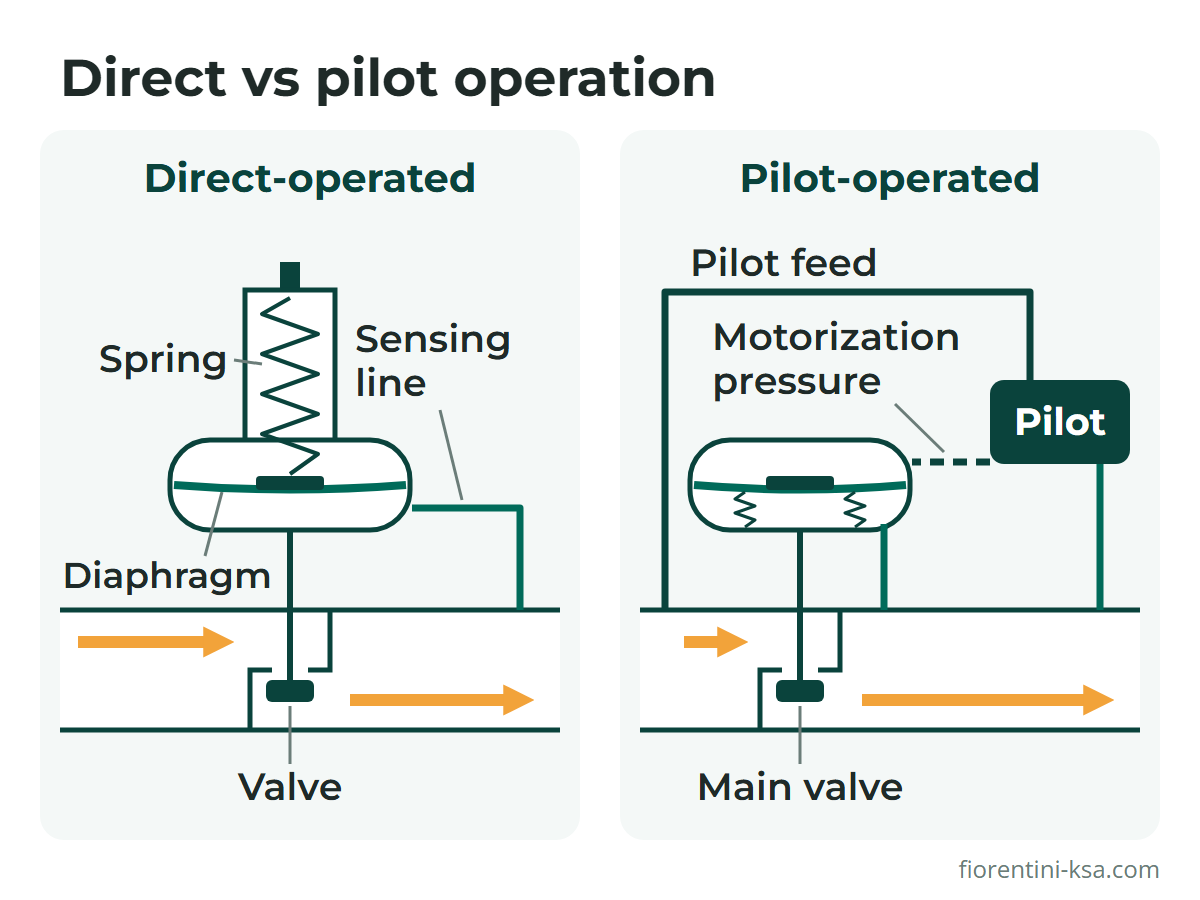
A gas pressure regulator compares its outlet pressure with a set point and moves a valve to correct the difference. The pilot-operated vs direct-operated choice comes down to what powers that correction. In a direct-operated regulator, outlet pressure on a diaphragm moves the valve directly against a spring. In a pilot-operated regulator, a small pilot senses outlet pressure and turns each deviation into a large change in the pressure driving the main valve.
As a result, direct-operated regulators are simpler, respond quickly and usually cost less. Pilot-operated regulators hold the set point more tightly over a wider flow range and come in larger sizes.
Key takeaways
- Direct-operated: outlet pressure on a diaphragm, balanced by a spring or a counter-pressure, positions the valve.
- Pilot-operated: a pilot amplifies small outlet-pressure changes into large changes of motorization pressure, so droop is much smaller.
- Droop limits a direct-operated regulator's usable capacity, so its capacity is often published per accuracy class.
- Pilot circuits need clean, dry gas and add maintenance.
- Minimum differential pressure and fail-open or fail-close behavior depend on the model, not on the operating principle.
In this article
How a direct-operated regulator works
EN 334 is the European standard for gas pressure regulators with inlet pressures up to 100 bar. It defines a direct-acting regulator as one in which the controlled variable itself supplies the net force that moves the control member. In practice, a spring pushes the valve open and fixes the set point. Outlet pressure, reaching the main diaphragm through an internal passage or a sensing line, pushes it closed. Our gas pressure regulator guide explains these parts.
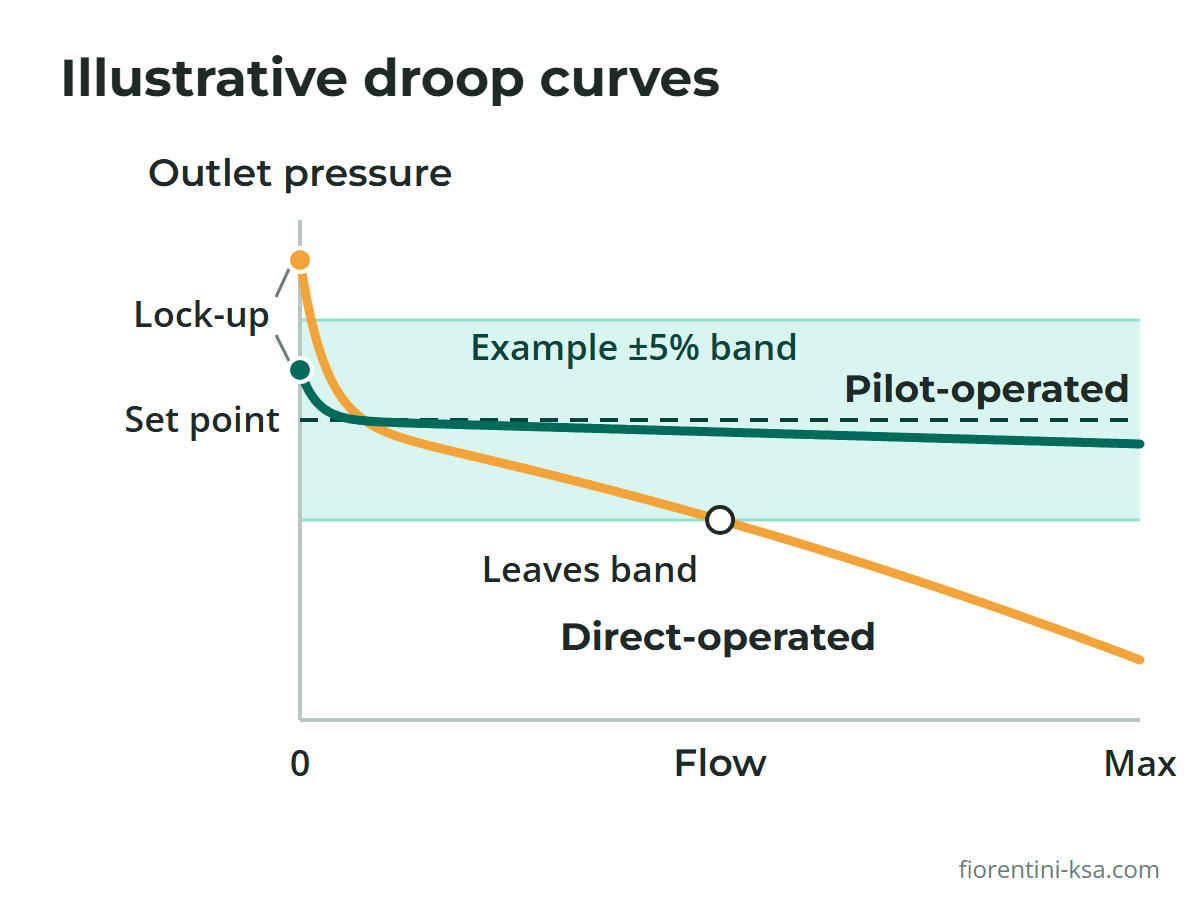
When demand rises, outlet pressure dips and the spring opens the valve until the forces balance again. When demand falls, the diaphragm pushes the valve back toward its seat. At zero flow the valve closes and outlet pressure settles slightly above the set point, at the lock-up pressure.
Why droop is built in
To open further, the spring must extend, and an extended spring pushes with less force. The diaphragm's effective area also changes as it moves, so each new balance is found at a slightly lower outlet pressure. This fall in outlet pressure as flow rises is called droop. Because only a change in outlet pressure can move the valve, good design can reduce droop but not remove it.
Variants you will meet
Most direct-operated regulators are spring loaded, such as the Dival 600 and the Norval, which reaches 8 inch. At high pressure, the Staflux 185 replaces the spring with a regulated gas counter-pressure in its top chamber. A small relief valve protects that chamber from overpressure caused by high ambient temperatures, a useful detail for Gulf sites.

How a pilot-operated regulator works
EN 334 calls this type a pilot-controlled regulator: a pilot supplies the net force that moves the control member. The pilot is a small regulator with its own setting spring, sensing diaphragm and valve. It sets the motorization pressure, often called loading pressure, in the main valve's actuator. Within the scope of EN 334, the main valve is moved by energy from the pipeline gas, not by an external power source.
The control loop works like this:
- Gas taken from upstream of the main valve feeds the pilot through a filter and, often, a small pre-regulator.
- The pilot compares outlet pressure, brought by a sensing line, with its spring setting.
- If outlet pressure falls, the pilot adjusts the motorization pressure so the main valve opens further. If outlet pressure rises, the valve is driven back toward closed.
- The pilot circuit bleeds continuously to the outlet through a small orifice or restrictor, so the motorization pressure can fall as well as rise.
The pilot's gain is what matters. A very small change in outlet pressure swings the motorization pressure enough to drive the main valve through its full stroke. The US pipeline safety agency PHMSA puts it simply: a pilot "multiplies a small change in downstream pressure into a large change in pressure applied to the regulator diaphragm."
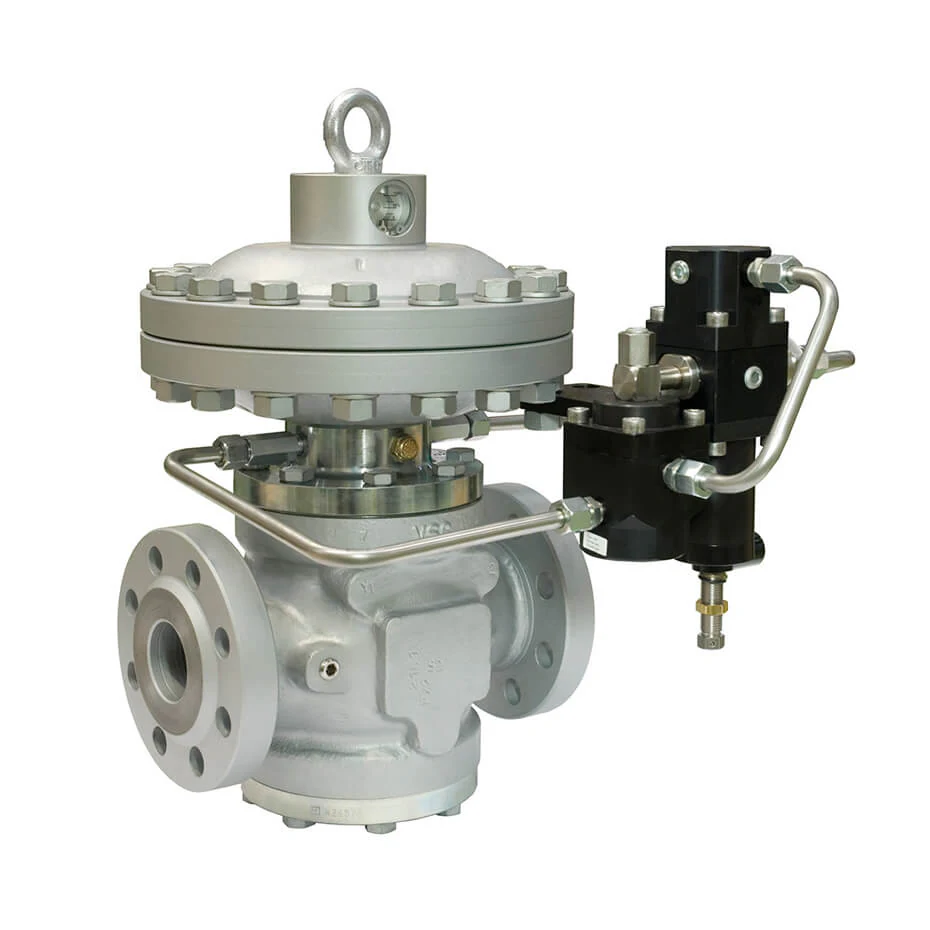
Fail-safe behavior is a design choice, not a feature of either type. The Reflux 819 is fail close under EN 334 with pilot series 200/A and fail open with series 210/A. Most direct-operated models in the Pietro Fiorentini range are fail open, but the Staflux Mini is fail close.
Pilots can also allow remote set-point adjustment: the Reflux 819 brochure lists pilot versions with electric or pneumatic remote setting.
Accuracy, droop, capacity and response compared
Accuracy and lock-up classes
In EN 334, the accuracy class (AC) is the maximum permitted deviation from the set point over a specified operating range, in percent of the set point. The lock-up pressure class (SG) is the maximum permitted rise above the set point at lock-up, also in percent.
| Model | Type | Tightest AC | Tightest SG | Sizes |
|---|---|---|---|---|
| Reflux 819 | Pilot-operated | 1 | 2.5 | 1 to 12 inch |
| Aperflux 851 | Pilot-operated | 2.5 | 10 | 1 to 10 inch |
| Aperval | Pilot-operated | 5 | 10 | 1 to 4 inch |
| Staflux 185 | Direct-operated | 5 | 10 | 1 to 3 inch |
| Norval | Direct-operated | 5 | 10 | 1 to 8 inch |
| Dival 600 | Direct-operated | 5 | 10 | 1 to 2 inch |
These are the tightest classes on each product page, and they depend on working conditions. Pilot operation alone does not guarantee a tighter class: the pilot-operated Aperval and the direct-operated Dival 600 both list AC 5.
Droop and usable capacity
A direct-operated regulator can often pass more gas than it delivers within a tight band, so its usable capacity depends on the accuracy you accept. The Norval brochure shows this for a 1-inch Norval with the 495 mm control head, at 2 bar inlet and 20 mbar outlet. It lists 300 Stm³/h (standard cubic meters per hour) at AC 10 and 470 Stm³/h at AC 20.
With little droop, a pilot-operated regulator can use more of its full-stroke capacity within its class. Pilot-operated bodies also go larger, up to 12 inch for the Reflux 819, while most direct-operated models in the range are 3 inch or smaller.
Speed of response
A direct-operated regulator reacts as soon as its diaphragm feels a change, which suits loads that switch quickly. Pietro Fiorentini highlights the Dival 600's fast response for industrial loads with sudden flow changes. In a pilot-operated regulator, the response also depends on the pilot circuit, which can be tuned. In the Aperflux 101, for example, the bleed rate through an adjustable restrictor influences the response time.
Minimum differential pressure
The minimum pressure drop a regulator needs is model-specific. A pilot-operated regulator needs enough drop to build the motorization pressure that strokes its main valve. The Reflux 819 lists 0.5 bar, and the Aperflux 851 lists 0.5 bar with more than 2 bar recommended. Yet the pilot-operated Reval 182 lists 0.1 bar, like the direct-operated Dival 600, while the direct-operated Staflux Mini lists 1 bar. Check the margin at the lowest expected inlet pressure.
Dirt, hydrates and maintenance in practice
Pietro Fiorentini specifies previously filtered, non-corrosive gas for both types. Sand and dust are a real factor at many Saudi and GCC sites. Plan upstream filtration, such as an HFA-HFB dry gas filter, which filters to 5 micron as standard.
The pilot circuit is the more delicate part. Its small orifices and restrictor are more easily blocked by dust, liquids and ice than the main valve, so pilot circuits carry their own filters. The Reflux 819, for example, has a built-in pilot filter.
Large pressure drops also cool the gas (the Joule–Thomson effect). If the gas carries moisture, ice or hydrates (ice-like solids of water and gas) can form in those small passages. For the Reflux 819 pilot circuit, Pietro Fiorentini lists a heating cable, an electrical heater and an anti-freeze device.
Preheating needs differ by model: the direct-operated Staflux 185, for example, is listed as not requiring gas pre-heating. Station preheating is covered in our pressure reducing and metering station guide.
Heat is the other Gulf factor. EN 334 covers operating temperatures from −20 °C to +60 °C, the range listed for every regulator named here. Check worst-case equipment temperatures in direct sun.
Maintenance and cost follow the parts count. A pilot-operated regulator adds the pilot, its filter, any pre-regulator and extra tubing to the parts of a direct-operated one. Direct-operated regulators are therefore usually the lower-cost option. Top-entry bodies, used on the Reflux 819, Dival 600, Norval and Staflux 185, allow servicing without removing the body from the line.
On any regulator, protect the sensing lines. PHMSA notes that if a spring regulator's control line breaks, the diaphragm loses its gas pressure and the regulator opens wide.
Pilot-operated vs direct-operated: comparison and decision guide
| Criterion | Direct-operated | Pilot-operated |
|---|---|---|
| Force that moves the valve | Outlet pressure on the diaphragm, against a spring or counter-pressure | Pilot-set motorization pressure |
| Droop and usable capacity | Grows with flow, limits capacity | Small droop, little capacity lost |
| Largest sizes in this range | 8 inch (Norval); most models 3 inch or smaller | 12 inch (Reflux 819) |
| Response | Fast, no intermediate stage | Depends on the pilot circuit; tunable on some models |
| Minimum differential | Model-specific: 0.1 bar (Dival 600), 1 bar (Staflux Mini) | Model-specific: 0.1 bar (Reval 182), 0.5 bar (Reflux 819) |
| Dirt, liquids and ice | Fewer small passages | Pilot needs filtration, sometimes heating |
| Maintenance and cost | Fewer parts, usually lower cost | More parts, usually higher cost |
| Remote set point | Manual adjustment | Possible with some pilots |
| Typical duty | Service connections, commercial and small industrial users, district stations | City gates, transmission, power plants, large industry, district stations |
Duties overlap in practice: the direct-operated Staflux 185, for example, is also listed for city gates and power generation. Screen with these steps, then confirm with the manufacturer's sizing data:
- Define the duty: flow range, inlet pressure range, set point and required accuracy.
- Try direct-operated first. If one delivers maximum flow at the lowest inlet pressure within the required class, its simplicity usually wins.
- Move to pilot-operated if it cannot, or if you need tight accuracy over a wide turndown, a large body or remote set-point adjustment.
- Check the minimum differential pressure at the lowest inlet pressure.
- Plan for gas quality and climate: filtration for both types, pilot heating where liquids or very cold gas are possible, and shade against high heat.
- Design the protection, such as a monitor, slam-shut or relief valve, in line with EN 12186 for gas pressure control stations. Our overpressure protection guide explains the options.
How Pietro Fiorentini can help
Pietro Fiorentini offers both types in its high–medium pressure regulator range and its medium–low pressure regulator range. Pietro Fiorentini Saudi Industry in Al Khobar supports projects with engineering, commissioning, training and original spare parts.
Not sure which type fits your station? Share your pressures and flow range, and we will help you compare the options: contact our engineers.
Frequently asked questions
What is the difference between a pilot-operated and a direct-operated regulator?
A direct-operated regulator moves its valve with outlet pressure acting on a diaphragm, balanced by a spring or a counter-pressure. A pilot-operated regulator uses a small pilot to sense outlet pressure and set the motorization pressure that drives the main valve. Because the pilot amplifies small errors, pilot-operated regulators droop less and suit larger flows.
Why is a pilot-operated regulator more accurate?
The pilot acts as an amplifier. A very small drop in outlet pressure changes the motorization pressure enough to drive the main valve through its full stroke. A direct-operated valve opens only as far as outlet pressure falls, so its droop grows with flow. Actual accuracy classes depend on the model and conditions.
What is droop in a gas pressure regulator?
Droop is the fall in outlet pressure below the set point as flow increases. In a direct-operated regulator it comes mainly from the spring, which pushes with less force as it extends, and from the diaphragm's changing effective area. EN 334 limits the total deviation, droop included, through the accuracy class AC.
Is a spring loaded gas regulator the same as a direct-acting regulator?
Usually, but not always. Most direct-acting regulators are spring loaded, with spring compression setting the outlet pressure. Some high-pressure designs, such as the Staflux 185, use a regulated gas counter-pressure instead. Pilot-operated regulators also contain a spring, in the pilot, but their main valve is moved by the motorization pressure.
Does a pilot-operated regulator need a minimum pressure differential?
Yes. Its main valve is driven by gas taken from the inlet side, so inlet pressure must exceed outlet pressure by enough to stroke the valve. The minimum is model-specific. The Reflux 819 lists 0.5 bar, the Aperflux 851 lists 0.5 bar with more than 2 bar recommended, and the Reval 182 lists 0.1 bar.
References
- EN 334:2019+A1:2024 Gas pressure regulators for inlet pressure up to 10 MPa (100 bar) – Swedish Institute for Standards (SIS)
- EN 12186:2025 Gas infrastructure – Gas pressure control stations for transmission and distribution – Functional requirements – Estonian Centre for Standardisation and Accreditation (EVS)
- Guidance Manual for Operators of Small Natural Gas Systems (January 2017) – US DOT PHMSA (copy hosted by the Railroad Commission of Texas)
- Reflux 819 technical brochure – Pietro Fiorentini
- Norval technical brochure – Pietro Fiorentini
- Aperflux 101 technical brochure – Pietro Fiorentini