

Search for a gas pressure regulator valve and you will meet several different devices. The pressure regulator is itself a valve, one that moves on its own to hold a set outlet pressure. A gas pressure control valve can look almost the same, but an actuator moves it on a signal from a controller. This guide explains each valve in the family, when a plant in Saudi Arabia, the UAE, Qatar, Kuwait, Bahrain or Oman should choose a regulator or a control valve, and how they share one line.
Key takeaways
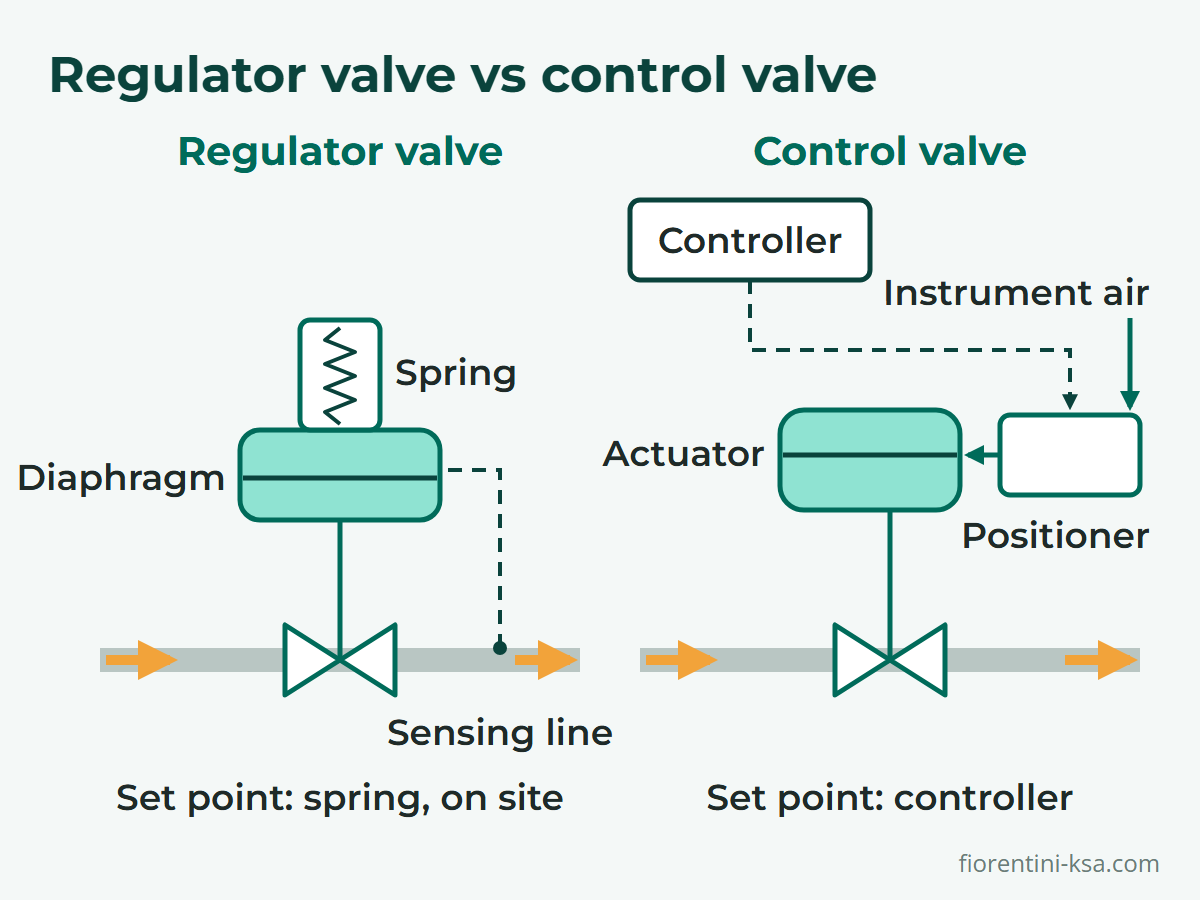
- A gas pressure regulator is self-operated: the outlet pressure acts on its diaphragm against a spring or a pilot load and moves the plug.
- A gas pressure control valve is actuated: a controller signal, a positioner and instrument air move the plug.
- Regulator for a fixed local set point or a site without instrument air; control valve when the set point must follow a control system.
- Monitor, slam shut and relief valves protect against overpressure; ball valves isolate; the filter protects them all.
- EN 334 covers regulators, EN 14382 safety shut-off devices, EN 12186 stations and IEC 60534 control valves.
In this article
- What a gas pressure regulator valve is
- How an actuated gas pressure control valve acts
- Regulator or control valve: which do I need?
- Monitor regulator: the standby valve
- Slam shut valve: the safety shut-off
- Relief valve: venting instead of closing
- Ball valves and the filter: isolation and protection
- How the valves work together on one line
- How Pietro Fiorentini can help
- Frequently asked questions
What a gas pressure regulator valve is
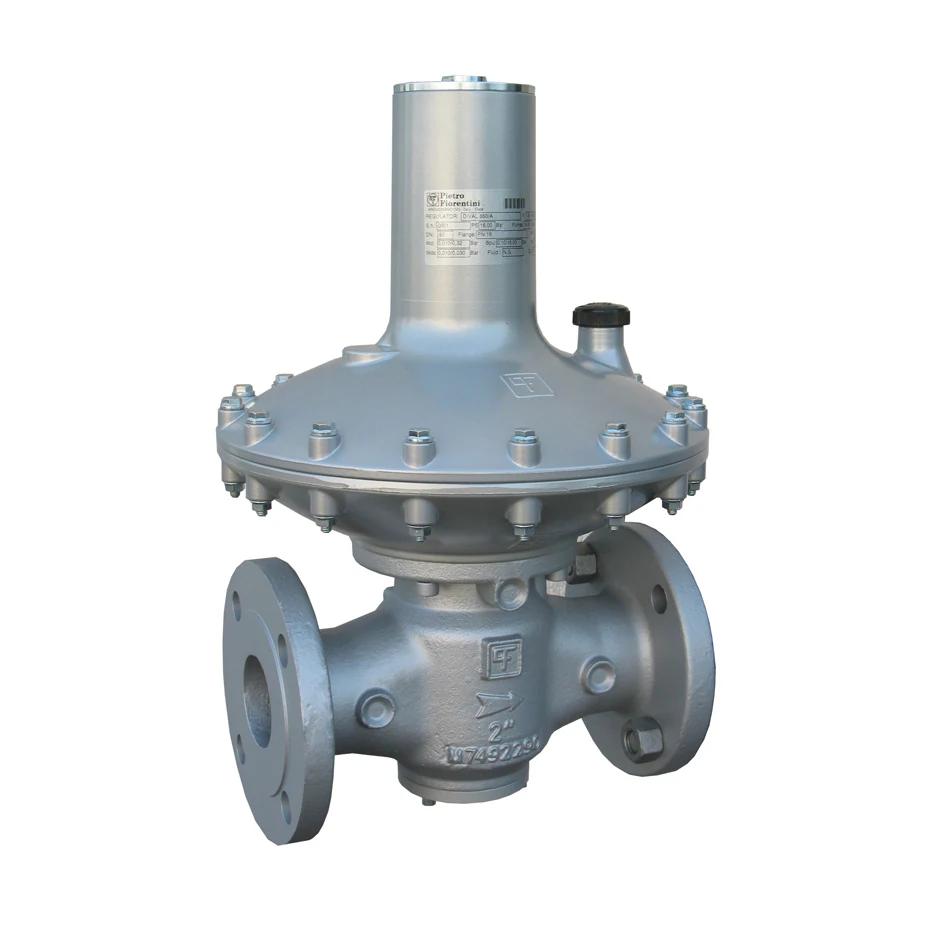
Pressure regulator, regulating valve, regulator valve and pressure reducing valve all name the same device: the valve in a gas line that reduces a higher, variable inlet pressure to a lower, steady outlet pressure. EN 334, the European standard for these devices, covers gas pressure regulators for inlet pressures up to 100 bar. Pietro Fiorentini groups its models on the gas pressure regulators page. One abbreviation needs care: PRV can mean a pressure reducing valve, which is a regulator, or a pressure relief valve, which vents gas.
Inside one body a regulator carries a diaphragm that senses pressure, a spring or pilot that loads it, and a plug and seat that throttle the gas; the gas pressure regulator guide walks through the three. It is self-operated: the gas it controls supplies all the energy it needs.
Outlet pressure pushes on the diaphragm and the spring pushes back. If demand rises and outlet pressure dips, the spring wins and the plug opens; if demand falls, the diaphragm pushes the plug toward the seat. The set point is fixed by the spring compression, adjusted by hand on site.
A pilot-operated regulator adds a small pilot that reads the outlet pressure and sets the loading pressure on the main diaphragm, so the main valve holds its set point more closely. The guide to pilot-operated vs direct-operated regulators compares the two. Either way, the regulator reacts to one variable only, the pressure at its diaphragm or pilot, and it needs no instrument air, electricity or control room.
How an actuated gas pressure control valve acts
A gas pressure control valve adds a control loop around the valve body. A transmitter measures the controlled variable, usually pressure or flow. A controller, such as a PLC or a distributed control system, compares it with the set point and sends an output, typically 4–20 mA or a pneumatic signal.
A positioner on the valve converts that signal into instrument air pressure and checks that the stem reaches the demanded position. An actuator, a diaphragm or piston with a spring, moves the plug.
The set point now lives in the controller, so it can be changed remotely, follow a schedule or depend on another measurement, and the valve can control flow rather than pressure. In return it needs instrument air, power and signal cabling, and a loop to maintain.
Fail position is decided differently too. EN 334 classifies each regulator model as fail open or fail close by its own design. In a spring-return control valve, the actuator spring drives the plug to a defined position when the air fails, and the version ordered sets which one.
The IEC 60534 series, Industrial-process control valves, is the reference for control valves of all types. Pietro Fiorentini lists its pneumatic, electric and manual options on the control and regulating valves page.
Worked case: the Reflux 919 control diaphragm valve
The Reflux 919 is a pneumatic control diaphragm valve for natural gas and other filtered, non-corrosive gases in high-pressure transmission and medium-pressure distribution. What makes it a control valve is the actuator and positioner. With a pneumatic positioner it follows a 0.21 to 1.03 bar or 0.42 to 2.06 bar signal; with the electro-pneumatic positioner option it follows 4–20 mA. It is designed to EN 334, like the regulators it works beside, and is supplied as direct action, air to close, or reverse action, air to open; the purchased version reacts as fail open or fail close under that standard.
Key figures: inlet pressure 1 to 100 barg; downstream pressure 0.5 to 95 barg in pressure control mode; DN 25 to DN 250 (1 to 10 inch); design temperature −20 °C to +60 °C; shut-off bubble tight, stated as better than class VIII to ANSI/FCI 70-3.
Regulator or control valve: which do I need?
- Is the set point fixed? If an operator changes it on site a few times a year, a regulator is simpler to run and maintain.
- Must the set point follow something? A remote command, a daily profile or a flow target calls for a control valve.
- Are instrument air and power available? Remote stations often have neither; a regulator works with the pipeline gas alone.
The two can share one station: self-operated regulating lines for the network, plus a control valve line where a plant needs remote set-point or flow control. The Reflux 919 shares the Reflux 819 regulator's main built-in accessories, the DB/819 silencer, the PM/819 monitor and the SB/82 or HB/97 slam shut, so its protection can match the regulator lines. With a line out of service, an operator can keep gas flowing by hand through a manual bypass and throttling valve such as the VLM.
Monitor regulator: the standby valve
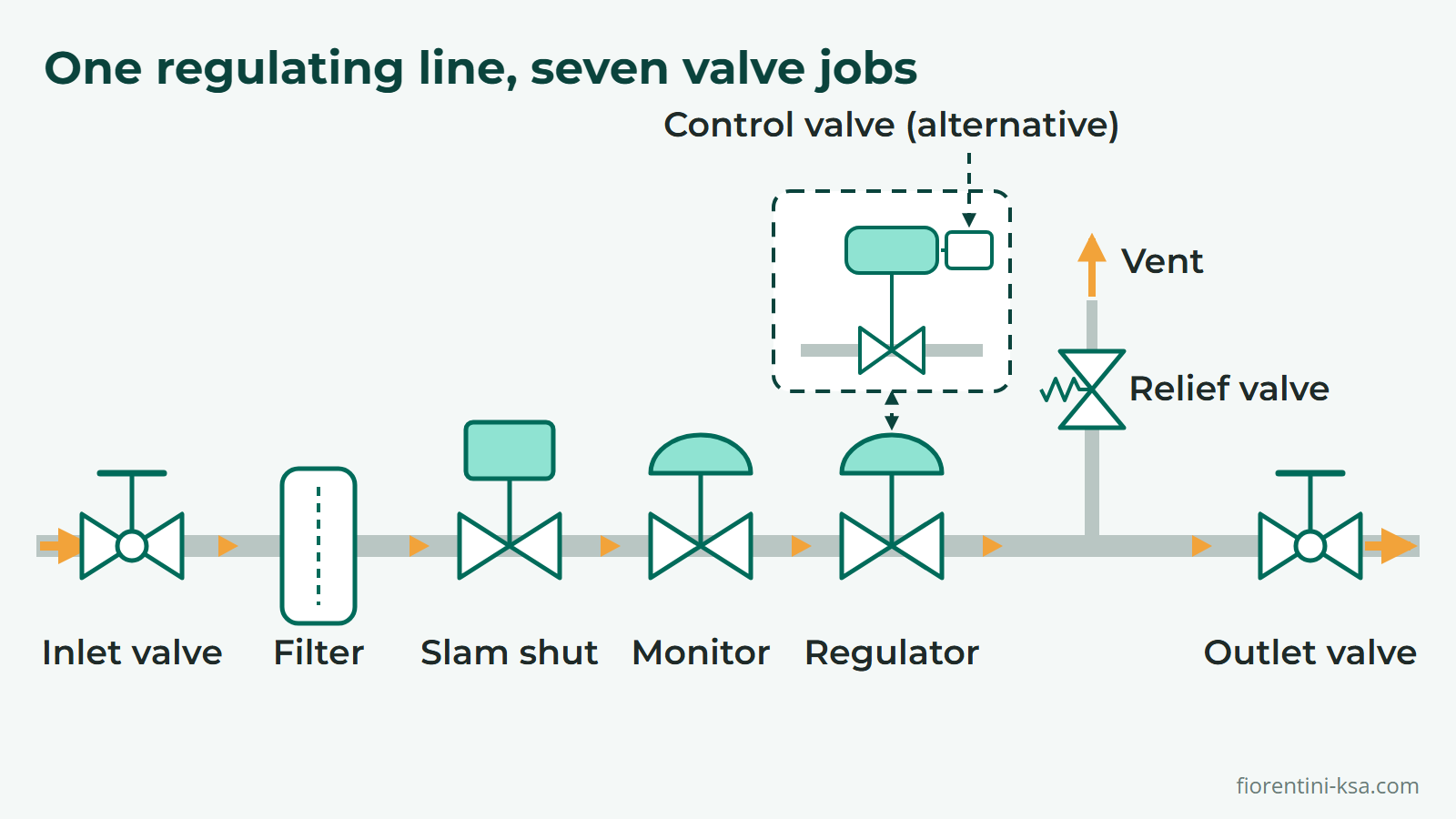
A monitor is a second regulator in series with the active one, normally upstream, with a set point a little above it, so in regular service it sits wide open and does nothing. If the active regulator fails open, outlet pressure rises to the monitor's set point and the monitor takes control. Supply continues and no gas is vented, and EN 12186 lists monitors among the pressure safety options for a station. Take-over speed, accelerating valves and alarms are covered in the guide to slam shut, monitor and relief valves.
Slam shut valve: the safety shut-off
A slam shut valve, or safety shut-off device, closes the line quickly when the pressure it senses leaves a set window: over-pressure shut-off (OPSO) and under-pressure shut-off (UPSO). It stays closed until someone resets it by hand. EN 14382 covers gas safety shut-off devices for inlet pressures up to 100 bar.
Pietro Fiorentini slam shut valves are designed to EN 14382 and trip within one second. The HBC 975 is a top-entry valve for 4 to 12 inch lines at design pressures up to 102 bar, with OPSO and UPSO settings from 0.2 to 90 barg. For 1 inch lines at up to 250 bar, including CNG trailers, the SBC Mini comes with ANSI 1500 flanges or threaded NPT ends. For medium and low pressure distribution up to 20 bar, the compact Dilock covers lines up to 2 inch.
Relief valve: venting instead of closing
A relief valve opens to atmosphere when line pressure exceeds its set value and recloses when it falls, so the supply continues. In most stations it is a small token relief that handles gas warming in a closed line, pressure shocks after a sudden flow change and slight leakage past a locked-up regulator, so a short event does not trip the slam shut. Pietro Fiorentini relief valves come in two families.
Direct-operated relief valves hold the plug on its seat with a spring; the VS/AM 58 is a 1 inch valve rated up to 100 bar. Pilot-operated relief valves use a sensitive pilot to open and close the main plug, for fast response in larger sizes. The PVS 782, designed for pressures up to 102 bar, comes in 4 to 8 inch with relief settings from 1.5 barg upward.

Ball valves and the filter: isolation and protection
The ball valves at the station inlet and outlet do not regulate anything. They isolate the line with a quarter turn and must match the pipeline class. The Pietro Fiorentini Group ball valves are made by TIV Valves to API 6D, the American Petroleum Institute specification for pipeline valves.
In a floating ball valve line pressure pushes the ball onto the downstream seat, which suits smaller bores. In a trunnion ball valve a trunnion carries the pressure load, so operating torque stays low in large bores; the range runs to Class 2500 and 60 inch.
Ahead of all these valves sits the filter, because sand and dust at Gulf sites damage seats, diaphragms and pilots. Pietro Fiorentini's HFA-HFB dry gas filters take design pressures to 100 bar, with a standard 5 micron cartridge.
How the valves work together on one line
The diagram below shows where each valve usually sits on one line; the gas pressure reducing station guide covers two-line layouts, preheating and metering. Where remote set-point or flow control is needed, a control valve such as the Reflux 919 takes the regulator's position, with the slam shut and monitor retained.
| Valve | Job | Energy source | Standard | Typical place |
|---|---|---|---|---|
| Pressure regulator | Holds outlet pressure at a local set point | Pipeline gas | EN 334 | Each regulating line |
| Control valve | Sets pressure or flow from a controller signal | Instrument air and a signal | IEC 60534 series | Plants, fuel gas skids |
| Monitor regulator | Standby; controls the outlet if the active regulator fails open | Pipeline gas | EN 334 | Upstream of the active regulator |
| Slam shut valve | Closes on OPSO or UPSO, manual reset | Spring, released by sensed pressure | EN 14382 | Upstream of the regulators |
| Relief valve | Vents short pressure rises, recloses | Spring or pilot | EN 12186 (venting devices); ISO 4126-4 (pilot-operated) | Downstream branch to a vent |
| Ball valve | Isolates the line | Hand, gear or actuator | API 6D (pipeline); ISO 17292 (plant, to DN 600) | Inlet and outlet |
How Pietro Fiorentini can help
Pietro Fiorentini Saudi Industry in Al Khobar supplies every valve in this family, from regulators and the Reflux 919 to slam shut and relief valves, TIV ball valves and dry gas filters. It also engineers complete pressure reducing and metering stations that combine them. Its services team supports sizing, commissioning and maintenance across the GCC and the Middle East.
Regulator or control valve for your line? Send us the inlet and outlet pressures, flow range, gas data and the control signal or air supply available at the site. Our engineers will recommend the valve family and the protection to go with it. Contact our engineers.
Frequently asked questions
Is a gas pressure regulator a valve?
Yes. A gas pressure regulator is a valve that operates itself: a plug and seat throttle the gas, and a diaphragm balanced by a spring or a pilot moves the plug to hold a set outlet pressure. Regulating valve, regulator valve and pressure reducing valve all describe this device, which EN 334 covers up to 100 bar inlet.
What is the difference between a pressure regulator and a control valve?
A regulator uses the pressure it controls as its only energy and sensing source, and its set point is fixed by a spring on site. A control valve is moved by an actuator that follows a controller signal through a positioner, so its set point can be remote or variable, and it can control flow as well as pressure.
What is the difference between a relief valve and a slam shut valve?
They answer overpressure in opposite ways. The relief valve releases a little gas to a safe vent and resets itself, so downstream users never notice; it is sized for small, short events. The slam shut valve keeps the gas in the pipe but cuts the supply, and an operator must find the cause before resetting it. Most lines use both, with the relief set to act first.
Do I need a monitor regulator?
A monitor is one way to protect a line against an active regulator failing open, alongside a slam shut valve and full-capacity relief. It keeps gas flowing without venting, which suits supplies that must not be interrupted. The choice depends on the station design, the downstream pressure limit and the operator's protection philosophy under EN 12186.
Which valve protects against overpressure?
Three do, in different ways: the monitor regulator takes over control, the relief valve vents the excess gas and the slam shut valve closes the line. A regulator or control valve on its own is not a protection device, because the failure being protected against is often its own.
References
- EN 334:2019+A1:2024 Gas pressure regulators for inlet pressure up to 10 MPa (100 bar) – SIS
- EN 14382:2019+A1:2024 Gas safety shut-off devices for inlet pressure up to 10 MPa (100 bar) – DIN Media
- EN 12186:2025 Gas pressure control stations for transmission and distribution – Functional requirements – SIS
- IEC 60534-1:2023 Industrial-process control valves – Part 1: Control valve terminology and general considerations – IEC
- ISO 17292:2015 Metal ball valves for petroleum, petrochemical and allied industries – GSO store
- Reflux 919 flyer FY0032ENG – Pietro Fiorentini