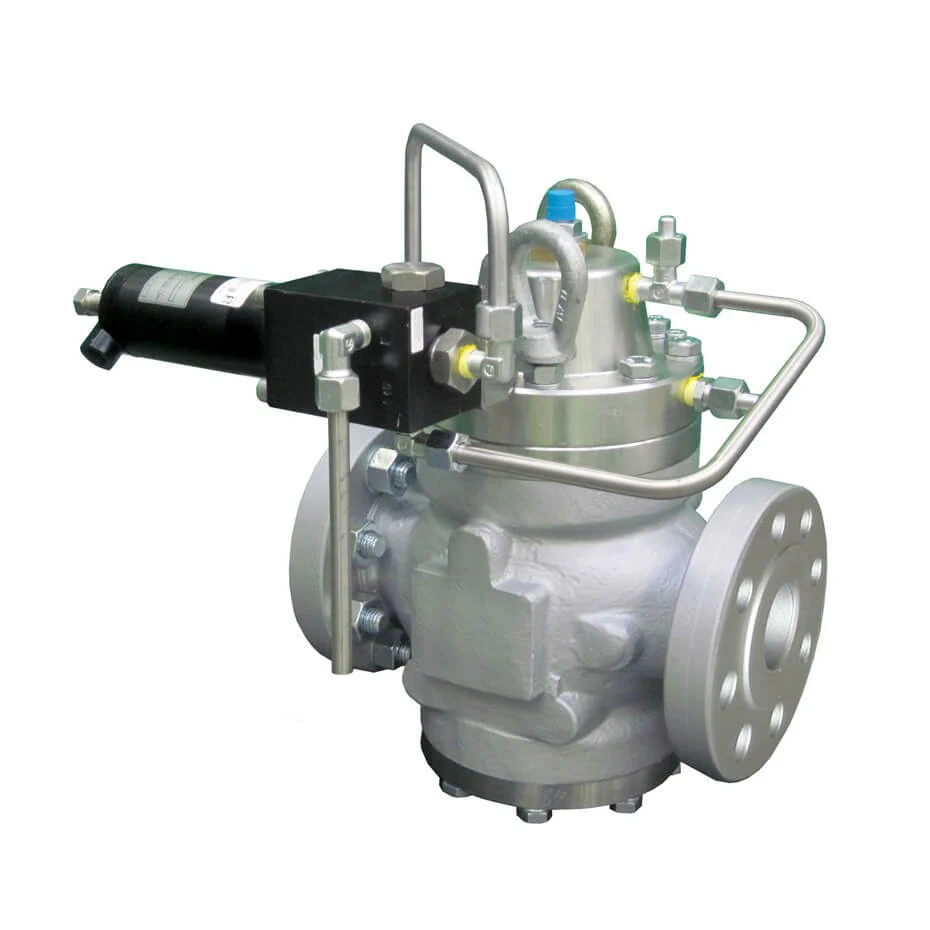
Pilot operated relief valves for gas protect high and medium pressure lines at city gates, compressor and booster stations, gas storage sites and power plants.

The PVS 782 and PVS 803, rated to 102 bar, relieve from 1.5 to 75 barg, cover 1 to 8 inch with ANSI 150, 300, 600 or PN 16 flanges, designed to ISO 4126-4 and certified to PED. Pietro Fiorentini supplies both for gas networks and industry in Saudi Arabia and the GCC: the UAE, Qatar, Kuwait, Bahrain and Oman.

Pietro Fiorentini pilot-operated relief valves are safety devices used in high and medium pressure applications. Thanks to their pilot action, they guarantee immediate action in case of line pressure variations. In the PVS 782 and PVS 803 the opening and the closing of the main plug is controlled by a pilot device which is very sensitive to the variations of the in-line pressures.

Pilot Operated Relief Valves: products

PVS 782 pilot operated gas relief valve by Pietro Fiorentini Pilot Operated
Relief Valve

PVS 782

Pilot operated relief valve, up to 102 bar.

View Details
PVS 803 pilot operated gas relief valve by Pietro Fiorentini Pilot Operated
Relief Valve

PVS 803

Pilot operated relief valve for high-pressure transmission systems and medium pressure distribution networks.

View Details

How to choose a pilot operated relief valve

Size comes first, then compare accuracy, materials, maintenance and testing.

  • Smaller lines: PVS 803

    The PVS 803 covers DN 25 to DN 150 (1 to 6 inch), so it fits smaller lines and district stations.

  • Larger relief duty: PVS 782

    The PVS 782 covers DN 100 to DN 200 (4 to 8 inch) for larger relief duty at city gates and transmission stations.

  • Shared ratings

    Both share the same 102 bar design pressure, the 1.5 to 75 barg relief range and a -20 to +60 °C temperature range.

  • Accuracy

    The PVS 803 is stated at a maximum overpressure accuracy of up to 10 percent, the PVS 782 up to 15 percent; both valves are bubble tight, better than class VIII to ANSI/FCI 70-3.

  • Body material by flange class

    Body material follows the flange class: cast steel ASTM A 216 WCB for ANSI 150 and PN 16, and ASTM A 352 LCC for ANSI 300 and 600.

  • Maintenance and testing

    Both valves have a top entry design for easier maintenance, and an optional manual push device lets operators test the valve; specific versions exist for pure hydrogen or blends, and both are biomethane compatible.

  • Smaller duties, what to send

    For small 1 inch venting duties a direct operated VS/AM 58 may be enough; our Al Khobar engineers can review relief sizing for a station in Jubail or Abu Dhabi and send matching technical documentation.

Frequently asked questions

How does a pilot operated relief valve work?

A small pilot senses the line pressure. When the pressure passes the set value, the pilot opens the main plug and the valve vents gas; when the pressure falls back, the pilot closes the plug again. Because the pilot is very sensitive to pressure changes, the PVS valves respond fast and keep high accuracy across the 1.5 to 75 barg relief range.

What is the difference between the PVS 782 and PVS 803?

They share the working principle, the 102 bar design pressure, the relief range and the flange options. The difference is size and accuracy: the PVS 803 covers 1 to 6 inch with maximum overpressure accuracy up to 10 percent, and the PVS 782 covers 4 to 8 inch with accuracy up to 15 percent. Choose by the required relief capacity and line size.

Which standards apply to the PVS relief valves?

The PVS 782 and PVS 803 are pilot operated safety valves designed to ISO 4126-4 and certified to the Pressure Equipment Directive 2014/68/EU (PED). Leakage is bubble tight, better than class VIII to ANSI/FCI 70-3, and end-to-end dimensions follow EN 334 and EN 14382.

Need Technical Assistance?

Our engineers are ready to help you select the right safety valve for your application.

Request a Quote Back to Valves & Filters